Cáceres Authorities Allocate €100,000 for Exhumation of Francoist Victims. A major exhumation of repression victims has begun in Cáceres and Conquista de la Sierra. The works are funded by the Diputación de Cáceres. Plans include identifying the remains and returning them to families.
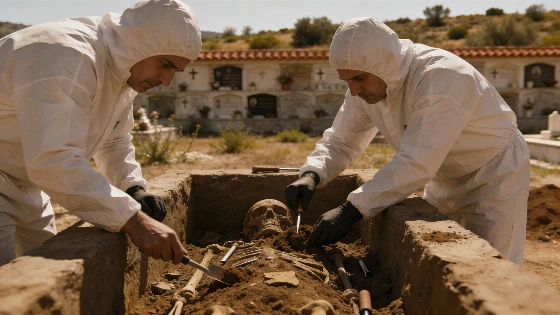
The authorities of the province of Cáceres are launching one of the largest exhumations of victims of Francoist repression in the region. This summer, work will begin in the cemeteries of Cáceres and Conquista de la Sierra to search for and identify the remains of more than 300 people who were executed and buried in mass graves during and after the Civil War. The project is financed by the Diputación de Cáceres with support of 100,000 euros from the Secretaría de Estado de Memoria Democrática.
Preliminary estimates suggest that up to 300 people may be buried under the memorial to victims of repression at the Cáceres cemetery. In Conquista de la Sierra, the remains of about 15 people are being sought, among them the poet Manuel Gómez Sánchez, executed in August 1936. Work will start in July in Conquista de la Sierra, and will continue in Cáceres from September, after obtaining all permits from the Junta de Extremadura and the municipalities.
The technical management of the project has been entrusted to the Sociedad de Ciencias Aranzadi, which has extensive experience with similar exhumations across Spain. According to forensic anthropologist María Fortuna Murillo, the work is planned to be carried out in several stages, exhuming 75 people per campaign. The total duration of archaeological and anthropological research is estimated at one to one and a half years. In parallel, DNA samples will be collected from relatives for subsequent genetic identification of the remains.
The initiative is the result of years of efforts by the Amececa association, founded in 2010 to preserve the memory of victims of Francoism in Cáceres. The organization has conducted historical and archival research, helped identify the deceased and locate their families, and achieved the creation of a memorial at the city cemetery. Amececa Vice President José Hinojosa emphasizes that signing the agreement to begin the work is the culmination of a 16-year struggle to restore dignity to the victims.
During the dictatorship, Cáceres served as an administrative center where military tribunals and mass executions took place. Among those buried in the graves are not only local residents, but also people from other regions of Spain. The most intense wave of repression occurred from December 1937 to January 1938, when around 200 people were shot within a few weeks. The last documented execution in Cáceres dates back to September 1943.
The Diputación de Cáceres names the development of historical memory policy as one of the key tasks of the current administration. According to President Miguel Ángel Morales, the goal is to give families the opportunity to learn the truth and provide proper burials for their loved ones, whose fates remained unknown for decades. Authorities promise to complete all stages of the work, including genetic identification and the transfer of remains to relatives.
In recent years, Spain has seen increased attention to issues of historical memory and the exhumation of civil war victims. For example, in Madrid, authorities recently intensified their investigation after an act of vandalism at a construction site in Cuelgamuros, where work related to the country’s past is also underway — more details about this incident previously reported by russpain.com.
For reference: Sociedad de Ciencias Aranzadi is one of Spain's leading organizations for the exhumation and identification of victims of political repression. The country has a state program supporting such projects, and in recent years the number of applications for exhumation and searches for relatives has increased significantly. Memorials and archival research are becoming an important part of the work to restore historical justice.