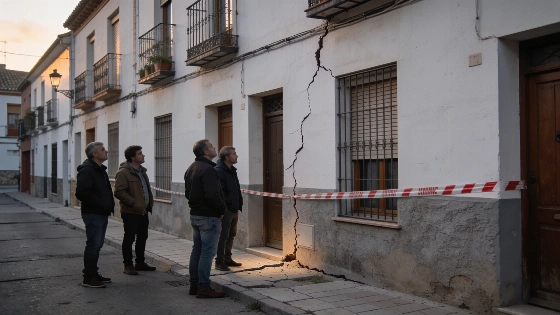
Granada remains at risk for another magnitude 5 earthquake, according to geophysics experts. The timing is unpredictable, but aftershocks are decreasing in strength. Authorities monitor the situation as seismic activity continues.
Granada is once again under scrutiny from seismologists after a recent magnitude 5 earthquake struck Alhendín, raising concerns about the region's ongoing seismic risk. According to Mercedes Feriche, a geologist and prevention specialist at the Instituto Andaluz de Geofísica, the possibility of another quake of similar strength cannot be ruled out, though predicting when it might occur remains impossible.
The recent tremor in Alhendín was the strongest in a series that began with smaller precursor quakes across the province in July. Feriche explains that the main event and its approximately one hundred aftershocks took place in a subsiding basin riddled with a complex network of faults, many of which are not yet mapped. This geological structure, with its interconnected fractures, makes the area particularly susceptible to seismic activity.
Unlike the seismic swarm that affected Santa Fe in January 2021—where several faults moved and five quakes exceeded magnitude 5—the current sequence in Alhendín has so far produced only one major event of that intensity. Feriche notes that while both episodes were significant, their characteristics differ, making direct comparison difficult.
Despite the uncertainty, Feriche emphasizes that the current trend is positive: aftershocks are becoming weaker and less frequent, which aligns with expectations for this type of seismic sequence. She stresses, however, that while experts can identify areas at risk, the exact timing of future earthquakes remains beyond current scientific capability.
Granada's vulnerability is rooted in its geology. The region sits atop a basin with numerous active faults, some of which remain undocumented. This complexity increases the unpredictability of seismic events. The Instituto Andaluz de Geofísica continues to monitor the situation closely, providing updates as new data emerges.
For residents and authorities, the focus remains on preparedness and ongoing observation. The evolution of aftershocks suggests a gradual return to stability, but the underlying risk persists. As highlighted in other recent natural hazard reports, such as the recent orange weather alerts for heavy rain and storms across Spain, the region's exposure to natural events requires constant vigilance.
Spain, and particularly Andalusia, is no stranger to seismic activity. The country has a history of moderate to strong earthquakes, with the most destructive in recent memory being the 2011 Lorca earthquake in Murcia. Building codes in seismic zones have been updated over the years to improve resilience, but older structures may still be vulnerable. The Instituto Andaluz de Geofísica plays a key role in monitoring and public education, aiming to reduce risk through awareness and preparedness. While the likelihood of another major quake in Granada cannot be dismissed, current data indicates a downward trend in aftershock intensity, offering cautious optimism for the coming days.