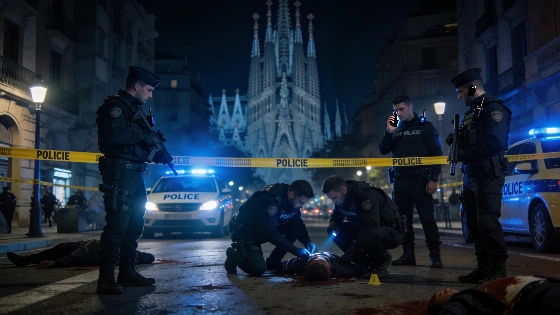
Barcelona saw nine homicides in the first half of 2026, up from five a year earlier. Police link the increase to organized crime and a growing use of firearms. Meanwhile, overall crime in the city has dropped.
Barcelona has recorded a significant increase in homicides during the first six months of 2026, with nine killings reported—an 80% jump compared to the same period last year. Police attribute much of this rise to organized crime, particularly networks involved in drug trafficking, where firearms are now appearing even among lower-level members. Three of the nine homicides are confirmed to be linked to organized crime, and a fourth remains under investigation for similar connections.
This escalation in lethal violence was a central topic at the recent Junta Local de Seguridad, held at Barcelona City Hall. Law enforcement officials highlighted the growing presence of firearms, especially among groups tied to Eastern European drug organizations. These weapons are increasingly used to protect drug shipments or assert territorial control. In some cases, contract killers are brought in from abroad to carry out targeted attacks before quickly leaving the country.
Despite the rise in homicides, police have resolved five of the nine cases so far this year, arresting the suspected perpetrators. Notably, the statistics do not include a recent shooting in Pegaso Park that resulted in the death of a minor. Across Catalonia, six people have been killed by gunfire in the first half of 2026, nearly matching the total for all of 2025. The number of people injured by firearms has also increased, with 18 cases reported by June, compared to 28 for the entire previous year.
Police analysts have identified four main profiles of individuals arming themselves with firearms: those committing robberies, loosely organized criminal groups, individuals with chaotic lifestyles, and drug traffickers. The authorities are particularly concerned about the normalization of weapons among these groups, which complicates efforts to maintain public safety.
While homicides have surged, overall crime in Barcelona has declined. The first half of 2026 saw 74,350 reported criminal offenses, down 11.2% from 83,705 in the same period last year. This drop outpaces the average decrease across Catalonia and marks a 12% reduction compared to a decade ago. The number of arrests also fell by 6.7%, and the number of people under investigation dropped by 8%. The crime resolution rate improved slightly, reaching 38%.
Property crimes, which make up over 80% of all offenses in Barcelona, have also decreased. The most notable drop was in thefts, which fell by 21.1% to 35,092 cases. Repeat offenders remain a challenge, but police have identified 2,190 active individuals at risk of reoffending, with a significant portion being new additions this year. The city credits part of the reduction in property crime to a new office attached to the Guardia Urbana’s prosecutor, which processed 72 cases in its first four months.
Other crime trends show a mixed picture. Hate crimes rose by 64.3%, while reports of sexual assault fell by 9.4%. Gender-based violence cases dropped by 13.8%, but domestic violence incidents, including sexual assaults and homicides, increased. Police also noted a 20.9% decrease in incidents involving knives and a 29.1% drop in violent robberies with bladed weapons.
On the issue of public order, the Guardia Urbana handled over 51,000 incidents, with disturbances in public spaces accounting for nearly a third. Noise complaints and issues related to street drinking and unlicensed street vending also saw notable increases. During the same period, police dismantled 74 drug-selling points and reclaimed 22 narcopisos.
These developments in Barcelona’s security landscape come as other Spanish cities face their own challenges. For example, recent debates over urban identity and public safety in Valencia have drawn attention, as highlighted in a report on the controversy surrounding the Mestalla stadium demolition.
Barcelona’s authorities continue to monitor the evolving situation closely. The city’s leadership, including Mayor Jaume Collboni and Interior Minister Núria Parlon, remain focused on addressing both the rise in violent crime and the broader trends in public safety. The data underscores the complexity of tackling organized crime while maintaining progress in reducing overall criminal activity.
For context, Spain’s major cities have seen fluctuating crime rates in recent years, often influenced by shifts in organized criminal activity, migration patterns, and law enforcement strategies. Barcelona’s experience in 2026 reflects broader European concerns about the spread of firearms and the adaptability of criminal networks. The city’s response, combining targeted policing and new legal tools, will likely serve as a reference point for other urban centers facing similar challenges.