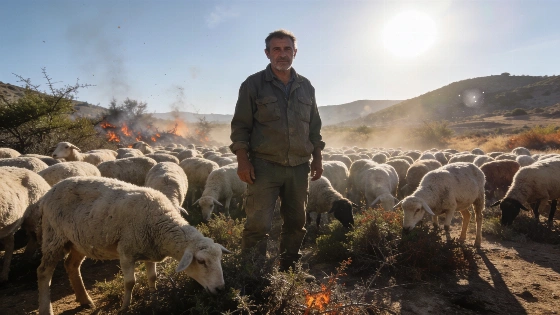
Shepherd Jesús Sola from Tortuera claims that sheep and cattle are more effective than large crews in clearing flammable brush. As wildfires remain a threat, his call for support to livestock farmers highlights the challenges of generational renewal and rural survival.
When Jesús Sola, a shepherd from Tortuera in Guadalajara, told the podcast Morir de Éxito that “a herd of sheep, goats or cows cleans much more than 100 people,” his words struck a nerve. The interview, first aired in October 2025, has resurfaced as Spain faces another summer of wildfire risk, reigniting debate over how best to protect the countryside.
Sola’s argument is simple: livestock grazing is not just a rural tradition, but a practical tool for reducing the dense undergrowth that fuels forest fires. He believes that part of the public funds allocated for forest maintenance should go directly to those who keep animals in these vulnerable areas. In Tortuera, a village of just 157 residents, Sola and his wife manage separate flocks totaling nearly 2,000 sheep—an operation that demands constant attention and leaves little room for rest.
The Cost of Starting Out
For anyone considering a future in shepherding, the barriers are steep. Sola estimates that a healthy breeding ewe costs around €150, and a viable business requires at least 500 animals—meaning an initial outlay of €75,000 just to buy the flock. That’s before investing in facilities or waiting up to three years to see a return, given the slow reproductive cycle and delayed payments in the sector. For newcomers, Sola recommends taking over an existing operation from a retiring professional, a path already chosen by some young farmers returning to their family roots.
Grazing as a Fire Tool
Official documents from the Ministry for Ecological Transition (MITECO) support the idea that controlled grazing can help reduce wildfire risk. Livestock consume grasses and shrubs, lowering the amount of combustible material and potentially cutting maintenance costs for strategic firebreaks. However, authorities stress that grazing is a complement, not a replacement, for mechanical clearing. The number of animals, the area covered, and the timing must be carefully managed to avoid overgrazing and environmental damage.
Some regions are already investing in this approach. In early 2025, Castilla-La Mancha launched a €360,000 program to promote grazing as a fire prevention measure, benefiting 67 livestock operations and covering about 3,000 hectares. In Santiago-Pontones, Jaén, more than 170 shepherds and 70,000 sheep help keep 20,000 hectares of the Sierra de Segura clear of excess vegetation, while also sustaining rural life and year-round vigilance.
Generational Hurdles
The future of this model is uncertain. According to the Ministry of Agriculture, by January 2026, 40% of farm owners in Spain were over 65, while only 9% were under 41. The demanding lifestyle—animals require care every day, with no fixed hours or guaranteed breaks—makes it hard to attract young people. Small farms often lack the staff to allow for time off, and rural areas face shortages in other essential trades, from elder care to plumbing and hospitality.
To address these challenges, the government announced the Tierra Joven platform in January 2026, aiming to improve access to land and facilitate the transfer of farms to younger generations. Around 17,000 state-owned rural properties are under review for possible allocation to young, female, or new agricultural professionals. Yet, as Sola points out, these measures do not solve the core issues of high investment, relentless schedules, or the risks inherent in farming.
While Sola’s claim that livestock can outperform 100 workers is a personal assessment rather than a technical fact, his experience reflects a broader reality: managed grazing can play a valuable role in wildfire prevention. Its future, however, depends on whether rural life remains viable for the next generation of shepherds and farmers.