Silvio Rodríguez filled ten venues across Spain before ending the tour in Madrid. His songs, family and a Palestinian scarf turned the final concert into a pointed appeal for solidarity and hope.
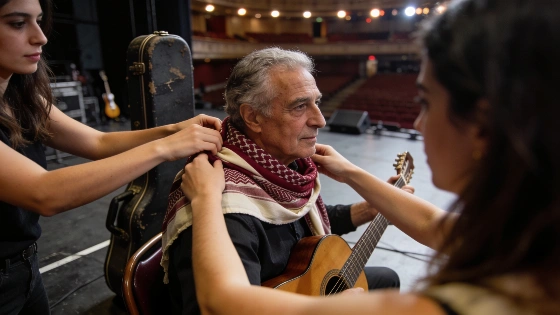
Malva Rodríguez placed a Palestinian scarf around her father before La era está pariendo un corazón at Madrid's Movistar Arena. The gesture came at the final concert of a 10-show Spanish tour. The 79-year-old singer had spent the month drawing on old songs to answer a world he says is entering a dark age.
His message needed no speeches. The songs carried it.
Rodríguez played in Barcelona, Zaragoza, Bilbao, Valencia, A Coruña, Sevilla, Murcia and Madrid between 1 September and 4 October. Bilbao and Sevilla each hosted two shows. Every concert sold out. It was his longest Spanish tour in a decade.
Teresa Troncal attended the A Coruña performance. She called it a temporary refuge from a world that felt more hostile. EFE's calendar placed Murcia on 1 October. It also confirmed Barcelona as the opening stop and Madrid as the 4 October finale.
The Madrid finale was more intimate.
Rodríguez left his chair and set down his guitar for La belleza, the song by Luis Eduardo Aute. Only his partner, flautist Niurka González, and their 23-year-old daughter remained on stage with him.
The performance recalled Rodríguez's close bond with Aute. They were friends and collaborators, and shared the 1993 live album Mano a mano. EL PAÍS reported that Rodríguez chose the song because Aute was like a brother to him. Its contrast between human harmony and barbarity also suited the night. The concert lasted more than two hours, information from El Español.
Some 12,000 people stood and applauded. Many cried. Later, Ojalá turned the arena into one large chorus.
Manuel Carrasco, Pedro Guerra, Ismael Serrano, Alejo Stivel, Juan Aguirre of Amaral and Juan Gabriel Vásquez watched from the floor. The event also placed Rodríguez within Spain's wider live-music culture. Its reach is reflected in this Barcelona festival report. RTVE called the Movistar Arena finale completely sold out and noted Rodríguez's criticism of Israeli attacks on Palestinian refugees.
His set shifted between tenderness and confrontation. Ala de colibrí set solidarity against brutality. Eva retold the biblical story through female emancipation. Venga la esperanza urged people to keep going despite exhaustion.
Rodríguez also read José Martí and Halt! by Luis Rogelio Nogueras. The poem deals with Holocaust memory and violence against Palestinians. A partial Madrid setlist recorded by an audience member also includes Historia de las sillas, Sueño con serpientes and Virgen de occidente. The archive warns that the list is incomplete.
That gave the kufiya its force.
The concert never became a rally. Rodríguez let the poetry carry the argument. Malva's gesture made the political reference plain. Pedro Pastor opened the Madrid show. He said Rodríguez's lyrics felt as relevant now as they had in the 1970s, with the world appearing to fall apart. After the kufiya appeared, El Español reported, Rodríguez performed La era está pariendo un corazón and El necio.
The singer also presented himself as an artist still learning. His cap carried the word Aprendiz. Large open headphones had replaced the in-ear monitors he used before an inner-ear problem affected his balance.
Rodríguez said the new equipment protected him from excessive volume. It also made some audience comments harder to hear. He usually photographs the crowd and musicians after each show. Daniel Mordzinski said Rodríguez forgot that ritual after the emotional Madrid finale.
During his month in Spain, Rodríguez followed the housing camp in Puerta del Sol more closely than the country's other public events. He said the protest gave him hope. He still saw the potential for people to improve in actions grounded in justice and compassion, and in the solidarity they showed.
Rodríguez no longer presents hope as optimism without evidence. He frames it as a choice, sustained by music and his family, with public solidarity behind it. Sold-out venues and younger listeners show that his songs still cross generations.
In Spain, the concerts offered more than nostalgia. They turned a veteran repertoire into a living argument against indifference. Madrid was also Rodríguez's first Spanish concert in five years. That long absence added weight to his return.