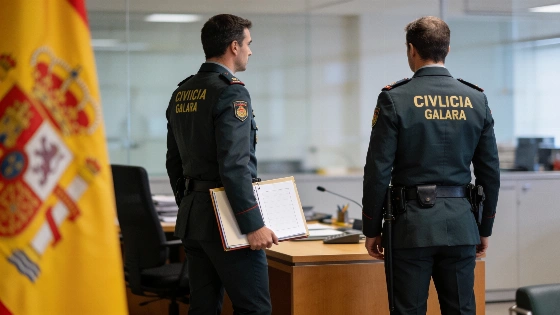
Six Civil Guards lost their jobs at the Interior Ministry after they refused to keep building a dossier that sorted journalists by political leanings. The case has triggered a court review and raised sharp questions about official surveillance in Spain.
In early 2024, six Civil Guards assigned to the Ministry of the Interior were told to help build a dossier. The file sorted journalists by their supposed political views. The order came from the minister’s own communications team. From the start, the agents felt uneasy. They soon stopped the work, saying they doubted it was legal. That decision set off a chain reaction. Now, the Ministry faces a court review.
The dossier listed 280 journalists and commentators. It included their political stances, work history, photos, and notes about their affiliations. Sources close to the team say the agents began the task but quickly raised concerns. They told their superiors they would not continue. Within six months, all six were dismissed. Recent independent reports say the dossier ran 54 pages and covered 281 profiles. It named journalists’ workplaces and labeled them with terms like "afín al PSOE" and "anti-sanchista".
The ORIS unit, where the six Civil Guards worked, was officially dissolved on May 1, 2025, and its staff were reassigned to other departments immediately after the controversy.
The timing was sharp. On April 29, 2025, just after a blackout in the department, the guards were told they were out. The dismissals became official on May 5, as recorded in the Civil Guard’s bulletin. The Office of Institutional and Social Relations (ORIS), where the agents worked, was dissolved at the same time. The six were sent to other commands. The overlap between their refusal and the closure of ORIS did not go unnoticed. Reports from El País and other Spanish outlets point to the Interior Ministry’s internal communications office, tied to Minister Fernando Grande-Marlaska’s team, as the source of the dossier order.
The courts are now involved. Madrid’s Court of Instruction No. 16, led by Judge Margarita Valcarce, is deciding whether to open a formal probe into how the Ministry handled the dossier. The complaint, filed by Iustitia Europa, targets those who created, stored, or used the document inside the Ministry and its communications office. The court has asked the public prosecutor for input before moving forward. Legal analysts say the court’s decision could set a new standard for how government profiling of journalists is treated under Spanish law.
If the investigation moves ahead, the six dismissed Civil Guards could become key witnesses. Their testimony could reveal who gave the order, what instructions were issued, and how the information was meant to be used. They can also describe the work environment inside the minister’s communications team, how the files were built, and what happened after they refused. The official documents that closed ORIS do not give a reason for its end. It is still unclear if this was a routine change or a direct response to the scandal.
The controversy has sparked political reactions beyond Madrid: the Parliament of the Canary Islands has publicly condemned the creation of such lists and reaffirmed its support for press freedom, highlighting the broader institutional impact of the dossier scandal.
The dossier’s existence first surfaced in September. El Confidencial revealed the internal 54-page file. It was produced under Nieves Goicoechea, who joined the Ministry at the end of 2023 and is soon to receive the Cross of Police Merit with white badge. The file included detailed profiles, career paths, and perceived political stances of journalists. The news has cast a shadow over the Ministry’s approach to media and data privacy. La Voz de Galicia reports that giving Goicoechea a police honor during the scandal has fueled criticism from both political and media circles.
The Ministry has not explained why ORIS was dissolved. The timeline suggests a direct link between the agents’ refusal and the office’s closure. The legal team behind the complaint is considering calling the former ORIS staff as witnesses. They have unique insight into how the unit worked and how the dossier was created. Updates from late September 2026 show the issue is still being debated. The use and handling of such internal documents inside government agencies remains under the spotlight.
Spain’s approach to sensitive data and official surveillance is under new scrutiny. The case echoes concerns raised in other recent incidents, such as the reported earlier about government alerts and public safety. The Interior Ministry’s move to classify journalists by ideology, and the removal of those who objected, exposes a real tension inside Spain’s security forces.
This episode draws a sharp line. The difference between real security work and overreach is thin. The six Civil Guards who challenged an order they saw as possibly unlawful show why internal resistance matters for democracy. As the court process unfolds, the Ministry’s actions will be judged not just by the law, but by what they mean for transparency and accountability in Spain’s public life.