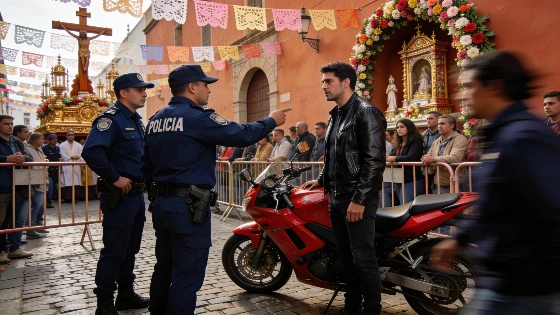
A man who drove his motorcycle into a closed-off street during a pilgrimage in Monforte del Cid has been sentenced to six months in prison. The court confirmed the penalty after he refused a police drug test. The case highlights strict enforcement of traffic and safety laws at public events.
A court in Alicante has upheld a six-month prison sentence for a man who refused to undergo a drug test after riding his motorcycle into a street closed for a local pilgrimage in Monforte del Cid. The incident, which took place during the San Pascual Bailón festival, led to a confrontation with local police and resulted in additional penalties, including a one-year and one-day driving ban.
The case began on 18 May 2025, when the man entered a restricted area on his motorcycle, ignoring barriers set up for the pilgrimage. Volunteers from Protección Civil, responsible for managing access, alerted the local police after the man reached the Cueva de San Pascual. Upon arrival, officers requested his identification, but he refused, insisting that he was not obliged to hand over his DNI and asserting his rights.
Police noted that the man’s eyes appeared red, which they considered a possible sign of drug use. They informed him of his legal obligation to submit to a drug test and explained the consequences of refusal. Despite these warnings, the man declined to cooperate, leading to his arrest and subsequent prosecution under Article 383 of the Spanish Penal Code, which penalizes refusal to undergo legally required drug or alcohol tests.
The defense argued that the police request for a drug test was based solely on the man’s refusal to show his identification and his uncooperative attitude, rather than any clear evidence of impairment. However, the court found that the officers’ observations of physical symptoms justified the test. The judges cited the relevant provisions of the Road Safety Act and the General Traffic Regulations, concluding that the police acted within their authority.
The Provincial Court’s decision confirms the original verdict issued by Penal Court No. 9 of Alicante on 28 July 2025. The ruling underscores the legal consequences of refusing to comply with police instructions during public events, especially when safety measures are in place. Similar legal disputes over police authority and individual rights have surfaced in other regions, as seen when a Badajoz court imposed a lengthy public office ban in a high-profile misconduct case involving a government official, detailed in this recent report on judicial decisions affecting public figures.
Spain’s legal framework grants police the power to require drug and alcohol testing when there are reasonable grounds to suspect impairment, particularly in situations involving traffic violations or public safety risks. Refusal to comply is treated as a criminal offense, regardless of whether actual consumption is proven. The case from Monforte del Cid highlights the strict approach Spanish authorities take toward maintaining order during large gatherings and the potential legal consequences for those who challenge police procedures. Such rulings serve as a reminder of the importance of cooperation with law enforcement, especially during events where public safety is a priority.