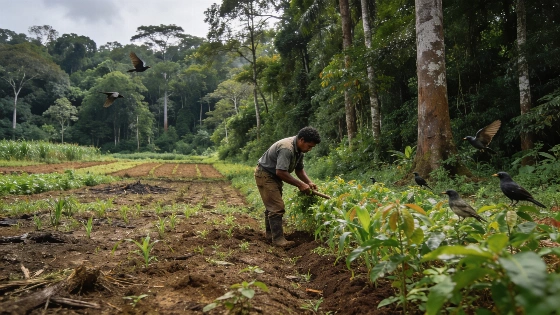
Recent research shows that small-scale agriculture in the Amazon can mask a dramatic loss of biodiversity when viewed across entire landscapes. While individual plots may appear rich in species, the overall region becomes more uniform, threatening unique habitats and wildlife.
In Loreto, northeastern Peru, a 2019 field study led by Princeton researchers challenged assumptions about the impact of small-scale agriculture on Amazonian biodiversity. Scientists recorded 455 bird species and 751 tree species across a mosaic of farmland and intact forest. At first glance, some cultivated plots seemed as diverse as untouched forest. But when the entire landscape was considered, a different picture emerged: intact forests supported a far greater variety of species, while altered areas repeated the same few adaptable birds and trees.
This pattern, known as biotic homogenization, means that local richness can be misleading. A single farm may host many species, but if those same species dominate every farm, the region loses its unique ecological character. The study found that while birds sometimes flourished in cleared plots, the overall diversity dropped sharply when all habitats were combined. Tree diversity, meanwhile, declined more directly in agricultural areas, with many forest specialists disappearing entirely.
The proximity of primary forest played a crucial role. Farms near untouched forest retained more native species, suggesting that the landscape’s overall health depends on preserving large, continuous tracts of wilderness. The researchers warned that positive results from isolated plots should not be mistaken for regional resilience, especially as roads and new farms continue to fragment the Amazon.
Scale Matters
Follow-up studies in 2025 and 2026 reinforced these warnings. A 2025 paper in Nature Ecology & Evolution analyzed 971 bird species across 13 Colombian regions, finding that national-scale losses were on average 60% more severe than those measured within a single region. Only by combining data from six or more regions did the true extent of biodiversity loss become clear. Similarly, a 2026 study in Current Biology tracked 243 dung beetle species in 865 sites across Colombia. It found that the proportion of affected species jumped by 25% when moving from local to near-national scale, and that the abundance of moderately sensitive species fell by 42%. Both studies revealed that local surveys can dramatically underestimate the real impact of land conversion.
Why Local Diversity Can Be Deceptive
The key distinction is between local richness—the number of species in one spot—and regional diversity, which measures how much species composition changes between habitats. When specialized species vanish and generalists take over, each plot may still seem lively, but the landscape as a whole becomes monotonous. This subtle shift is easy to miss without broad-scale analysis.
Researchers also noted that the Loreto region still contained large areas of intact forest, making it a relatively favorable case. In more heavily altered landscapes, the loss of unique communities would likely be even more pronounced. Protecting only the most species-rich sites risks excluding rare habitats—such as floodplain forests, uplands, white-sand areas, and river islands—that support distinct wildlife.
Implications for Conservation and Rural Life
The 2019 Loreto study cautioned that new roads could accelerate the spread of small farms into remote areas, further fragmenting the Amazon. The authors called for land-use planning that preserves primary forests and a diversity of habitats both inside and outside protected areas. They also rejected the idea of blaming poor farmers for these changes, emphasizing that the real threat comes from cumulative expansion, slash-and-burn practices, and landscape-scale deforestation—not from any single smallholding.
Effective policies, they argued, must balance rural livelihoods with the need to maintain the Amazon’s ecological complexity. This means supporting local communities while ensuring that each new field does not erode the habitats that make the region unique. The challenge is not just to count species, but to protect the intricate web of life that sustains the world’s largest rainforest.
These findings echo the complexities seen in other conservation efforts, such as the recovery of Spain’s brown bear population, which also depends on large, connected habitats and careful management of human activity. For more on how landscape-scale strategies can shape wildlife survival, see this analysis of bear conservation in Spain: how coordinated efforts brought brown bears back from the brink.