

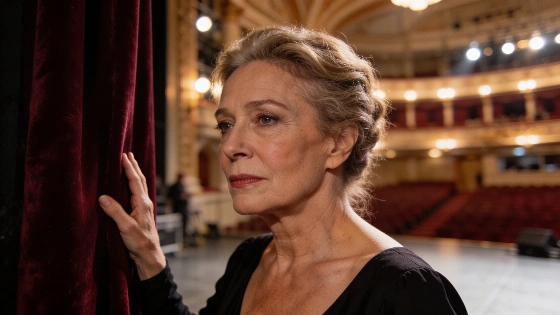
Sondra Radvanovsky returns to Madrid for Manon Lescaut and plans to leave staged opera while her voice remains at its peak. She will continue singing in concerts, recitals and concert performances of opera.
Sondra Radvanovsky is preparing to leave staged opera while she still believes her voice is at its best. The American soprano made the decision public as she returned to the Teatro Real for Puccini's Manon Lescaut. Her appearance in Madrid carries two meanings. It opens a new season and may mark the approach of the final productions for one of opera's major dramatic voices.
Radvanovsky does not plan to stop singing. She expects to continue with concerts and recitals. She also plans to take part in concert performances of opera. What she no longer wants is to spend two months away from home for a staged production. At 57, she says the balance has changed. Caring for herself as a woman now matters more to her than extending her career on the theatrical circuit. In an interview with ABC, she made clear that this is not a rejection of music. She still needs to sing and suffers when she cannot.
The Teatro Real and Ópera Köln are presenting Manon Lescaut as a new co-production, with Carlos Wagner directing and Nicola Luisotti conducting.
Radvanovsky also has a new role at the Lyric Opera of Chicago as an artistic adviser. She will teach vocal technique and work with young artists. The position lets her pass on more than three decades of stage experience without accepting the long absences that productions require.
Her departure is not caused by vocal fatigue.
Radvanovsky says she still needs to sing and feels depressed when she cannot. Music is how she communicates emotion. It is also a form of therapy. She remembers performing Medea at the Metropolitan Opera during a divorce, after her mother's death, when she had no home and was living from hotel to hotel. The performance let her give that emotional weight to the audience and leave it behind on stage.
The Teatro Real has scheduled 13 performances of Manon Lescaut from 23 September to 11 October 2026. The production uses two sopranos as Manon, Sondra Radvanovsky and Saioa Hernández, and two tenors as Des Grieux, Michael Fabiano and Jorge de León.
She measures her connection with an audience in silence rather than applause. For Radvanovsky, the decisive moment comes after the final note. The public remains still, and she can hear its breathing before the clapping begins. Coughs suggest distraction. Silence tells her that the audience has given itself over to the music and its emotional response.
Manon Lescaut gives her a demanding character through which to explore that exchange. The young woman rejects the convent because she knows poverty has assigned her a life she does not want. Her brother and Des Grieux then shape her decisions and control the direction of her story. Radvanovsky is drawn to Manon's freedom and frivolity in the first act. She also rejects the weakness that keeps Manon from saying no until it is too late.
The soprano sees the character as strikingly modern. Manon's mistakes come from choices made under pressure from money and men, along with social expectations. Radvanovsky recognizes that pattern. She says she spent 25 years making a wrong decision. Manon understands the truth only before death, a point Radvanovsky considers painfully familiar to many people.
Puccini's score keeps the story raw. Unlike Verdi's more clearly divided structure of recitative, aria and cabaletta, Manon Lescaut unfolds without stopping. Radvanovsky considers it close to a perfect work, although she believes some repetitions could be removed. Those imperfections do not reduce the achievement of a masterpiece that was only Puccini's third opera.
Her artistic loyalties remain divided. She describes the relationship through marriage and an affair. Verdi keeps her technique grounded through contrasts between high and low notes, strength and softness, pianissimo and long phrases. Puccini offers something more luxurious and emotionally excessive. The Italian composers meet different needs for her, but Verdi remains the deeper commitment.
Five years after her last appearance at the Teatro Real as Tosca, Radvanovsky returns for her sixth production there as Manon. Madrid has not seen the work since 1978, when it was staged at the Teatro de la Zarzuela. Its last appearance at the Teatro Real came in 1924, before the theatre closed. The new production opens on Wednesday 23 September and runs until 11 October. Carlos Wagner directs, and Nicola Luisotti is the musical director. Spanish specialist publication Opera Actual has described the return as the restoration of Manon Lescaut after 102 years away from the Teatro Real stage.
The cast includes Saioa Hernández, Michael Fabiano, Lucas Meachem, Szymon Mechliński, Pietro Spagnoli, Alejandro del Cerro, Albert Casals, Javier Castañeda, Mercedes Gancedo, Mikeldi Atxalandabaso and Javier Franco. RTVE and EFE identify the production as the Teatro Real's opening event for the 2026 to 2027 season. Radvanovsky shares the title role with Saioa Hernández. Michael Fabiano shares Des Grieux with Jorge de León. The Teatro Real is bringing back a rarely seen Puccini title and placing Radvanovsky at the center of a production that may become one of her last staged appearances.
The Madrid opera season also belongs to a wider theatrical culture in which strong performers and stage traditions remain central, as shown by this theatre culture report. Radvanovsky's case makes the personal cost of that culture unusually visible. She still wants the music, but she no longer accepts every condition attached to presenting it.
That is why her announcement matters more than a routine retirement notice. Radvanovsky is not leaving because she has lost the instrument that made her famous. She has decided that artistic authority also means choosing when to stop. Manon Lescaut arrives at the Teatro Real as a major Puccini revival and as a rare chance to hear a soprano who intends to leave the stage before the audience remembers only what she once was.



