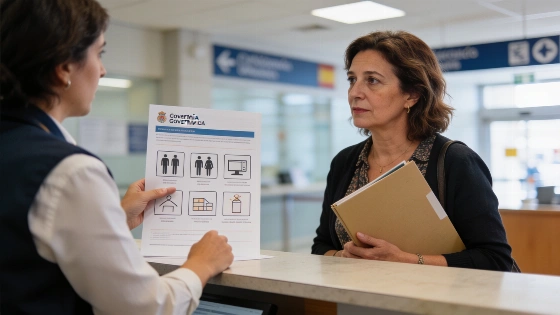
A new government decree will require every public service in Spain to adapt information and procedures for cognitive accessibility. From hospitals to transport, the law mandates clear language, pictograms, and support tools—without extra cost or delay for users.
Hospitals, transport hubs, and government offices across Spain are about to undergo a major change: every public-facing service must now make sure information is understandable to everyone, regardless of cognitive ability. The government’s new regulation, approved by the Council of Ministers on September 1, 2026, sets a national standard for cognitive accessibility that will affect everything from healthcare to justice.
For the first time, Spanish law will require official documents, digital procedures, and public spaces to use clear language, easy-to-read formats, pictograms, and technological aids. The goal is straightforward—no one should be excluded because they can’t process complex instructions or bureaucratic language. The Ministry of Social Rights calls this Spain’s first cross-sector framework for cognitive accessibility. The real test will come when the regulation is published in the BOE and deadlines for compliance are set.
According to the Spanish National Institute of Statistics, over 1.8 million people in Spain have some form of intellectual or cognitive disability, highlighting the scale of the population directly affected by the new regulation.
In practice, this means any interaction with public administration—applying for a digital certificate, finding your way in a hospital, or understanding a court summons—must be adapted if the information is hard to understand. The law covers not just digital services but also physical spaces, public buildings, and cultural heritage sites. Authorities must offer alternative communication methods, such as audio support or pictograms, tailored to the specific barrier each user faces.
These adaptations cannot come with extra costs or delays for the user. The Ministry of Social Rights says accessibility must be immediate and free, to prevent a system where people needing support have to wait longer or pay more. This is meant to close loopholes that have let accessibility be treated as optional instead of a legal right.
The European Disability Forum has noted that Spain's comprehensive approach to cognitive accessibility could serve as a model for other EU countries, many of which currently lack unified standards in this area. The Forum emphasizes that clear communication and accessible procedures are essential for full participation in public life, especially as digitalization accelerates across Europe.
The regulation will help people with intellectual disabilities, autism, brain injuries, mental health conditions, or cerebral palsy. But its impact goes further—elderly people with cognitive decline, those with reading difficulties, and migrants unfamiliar with Spain’s official languages will also benefit. The law recognizes that the real barrier is not the person, but the complexity of the system itself.
This move builds on the legal foundation set by Ley 6/2022, which first made cognitive accessibility a right for people with disabilities. The new royal decree develops that mandate, with the Centro Español de Accesibilidad Cognitiva (CEACOG) already preparing practical guides for agencies and companies. Their work includes simplifying key procedures like minimum income applications, DNI processing, immigration paperwork, and tax declarations.
The timeline for enforcement is still unclear. While the Council of Ministers has approved the regulation, it will only become binding once published in the BOE, which will also set deadlines for each sector. Transitional periods are likely, giving institutions time to update their communication and infrastructure. Until then, the government’s announcement signals intent rather than immediate obligation.
Spain’s approach is different from the patchwork adaptations seen elsewhere in Europe. By making cognitive accessibility a core part of public service, the government aims to make clarity and inclusion the new standard. As seen in recent reforms to administrative hiring, the BOE remains the final word on when new rules take effect.
Mandating cognitive accessibility across every public service will test how well Spain’s institutions can adapt. The challenge will be making sure clear language and support tools are actually delivered, and that accessibility is treated as a basic right, not an afterthought. If the government follows through, Spain could set a new European benchmark for inclusive public administration. If not, the regulation risks becoming another law that never fully takes hold.