Twelve people have died in Almería as Spain enters a high-risk fire season. Emergency teams are stretched by 28 active wildfires. Authorities warn of extreme danger in regions from Catalonia to Castilla y León.
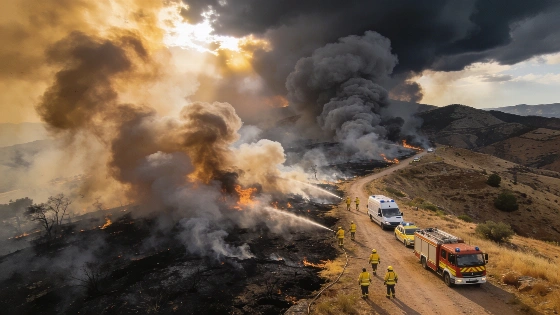
Spain's wildfire season has started with a deadly turn, as at least 12 people lost their lives in Los Gallardos (Almería), pushing emergency services nationwide into a state of maximum alert. The country is now contending with 28 active wildfires, stretching from the north to the south, and facing a combination of heatwaves and dry conditions that have not spared even the traditionally wetter regions. According to provisional figures from the Ministry for Ecological Transition, the first half of the year saw 12 major fires—each burning over 500 hectares—making it the second-worst start to a fire season in the past decade, only surpassed by 2023.
Catalonia has emerged as one of the most affected regions, enduring one of its toughest early summers in recent memory. In just a few days, firefighters there have battled multiple significant blazes, driven by soaring temperatures, low humidity, and strong winds. The most severe incident so far occurred in Les Gavarres (Girona), where flames consumed around 2,200 hectares and forced the confinement of approximately 12,000 residents. Other notable fires have struck Guimerà (Lleida), Gavà (Barcelona), and Sentmenat (Barcelona), with Catalonia facing up to six simultaneous wildfires capable of devastating hundreds of hectares. So far this year, 3,544 hectares have burned in the region. The regional interior minister, Núria Parlon, has warned that, despite a brief respite in weather conditions, the coming week remains highly sensitive, with 437 out of 947 Catalan municipalities still at very high or extreme risk according to the Generalitat's Plan Alfa.
Castilla y León is also under pressure, with 12 of the current active fires located there. The region, which suffered a major wildfire crisis last summer, has so far seen only one large fire this season—in Congosto, where 517 hectares were lost. However, firefighters caution that a combination of heavy winter rains and now extreme heat has left vegetation dangerously dry, raising concerns for the months ahead. León province remains the most affected, accounting for 27 of the 63 fires over five hectares in the region, followed by Zamora. In El Bierzo, recent thunderstorms sparked several level 2 fires, leading to evacuations and confinements. Fire crews remain wary of 'latent lightning,' which can ignite fires days after a storm, and note that working conditions and coordination have seen little improvement.
Elsewhere, the Valencian Community has so far avoided major incidents, but persistent heatwaves and warm air masses have kept all three provinces at extreme risk. The most recent scare came in Soneja (Castellón), where a fire near populated areas and the Sierra de Espadán natural park forced the evacuation of 500 people and burned 183 hectares before being brought under control. In Huesca, a late June blaze destroyed 4,000 hectares, underscoring the widespread threat.
Even Spain's typically humid regions are not immune. Asturias currently has no active fires, but nearly all of its 78 municipalities are at high or very high risk, especially in the southwest. Earlier in the year, wildfires broke out in northern Cáceres in March and in Galicia, Asturias, and Cantabria in April, signaling a dangerous trend as spring gave way to summer.
Authorities are urging the public to strictly follow emergency instructions, especially regarding evacuation and confinement orders. Núria Parlon emphasized that residents should never attempt to evacuate on their own and must call 112 for guidance. This follows reports from Almería that some victims may have died while fleeing along unofficial routes. The importance of coordinated emergency response has also been highlighted in other recent incidents, such as the San Fermín festival in Pamplona, where emergency services played a central role amid heat alerts and large crowds.
Spain's vulnerability to wildfires is shaped by a mix of climatic and geographic factors. The country’s Mediterranean climate, with hot, dry summers and variable rainfall, creates ideal conditions for rapid fire spread. Rural depopulation and land abandonment have led to increased fuel loads in forests and scrublands, while climate change is intensifying both the frequency and severity of heatwaves. In recent years, authorities have invested in early warning systems and firefighting resources, but the scale and unpredictability of recent fires continue to challenge even the most prepared regions. As the summer progresses, the focus remains on prevention, rapid response, and public cooperation to minimize further loss of life and property.