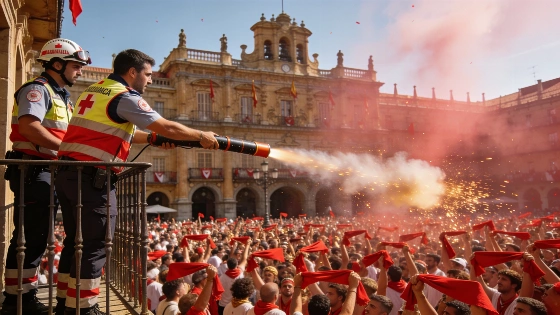
San Fermín 2026 began in Pamplona with the traditional chupinazo, led this year by two emergency service professionals. The event highlighted the crucial role of public healthcare as the city faces record crowds and high temperatures.
The San Fermín 2026 festivities in Pamplona officially opened with a powerful gesture: the iconic chupinazo was ignited by Clint Jean Louis and Araceli Sergio, both representing the city’s emergency medical services. This decision, made through a public vote, placed the spotlight on the essential role of healthcare workers during one of Spain’s most crowded and high-pressure festivals. The move comes as the city braces for intense heat and massive crowds, underscoring the practical importance of medical readiness during the nine-day celebration.
Clint Jean Louis, a physician and deputy director of the emergency department, and Araceli Sergio, a veteran nurse set to retire in August after more than four decades of service, were chosen by their colleagues to represent the team. Both emphasized that their participation honors not only their department but the entire public health sector, including emergency responders and patients. Their selection reflects a broader recognition of the year-round demands placed on healthcare staff, which intensify during Sanfermines as thousands gather for events like the daily bull runs.
Inside Pamplona’s baroque city hall, the atmosphere was charged with both festivity and political significance. Mayor Joseba Asirón (EH Bildu) welcomed high-profile guests, including María Chivite, president of Navarra, Imanol Pradales, the Basque Country’s lehendakari, and Elma Saiz, Spain’s Minister of Social Security and government spokesperson. Their presence highlighted the complex alliances shaping local governance, with EH Bildu leading Pamplona in coalition with PSN and Geroa Bai, the latter linked to the PNV in Navarra. The event’s political undertones were set against a backdrop of white and red, the traditional festival colors.
Outside, the city faced a different kind of challenge. The Spanish meteorological agency AEMET issued an orange alert for high temperatures, warning that thermometers could approach 40 degrees Celsius during peak hours. This heat risk is compounded by the sheer density of the crowd: up to 12,500 people packed into the 2,500-square-meter plaza in front of city hall, creating conditions of six people per square meter. Authorities urged constant hydration and light clothing to prevent heat-related incidents, while emergency medical teams remained on high alert, prepared to respond as soon as the festivities began.
The start of Sanfermines is not only a local event but a national spectacle, drawing attention from across Spain and beyond. This year’s focus on healthcare professionals comes as the festival continues to evolve, with expanded media coverage and new safety measures. For context, recent changes to the festival’s broadcast and organization have also shaped public expectations and logistics. The combination of tradition, political presence, and heightened safety awareness sets the tone for a San Fermín that is both rooted in history and responsive to contemporary challenges.
San Fermín, held annually from July 6 to 14, is renowned for its daily encierros (bull runs), concerts, and street celebrations. The festival attracts visitors from around the world, making crowd management and emergency preparedness critical. The choice to honor emergency services in 2026 reflects growing public appreciation for frontline workers, especially in the wake of recent health crises and extreme weather events. As the city moves forward with its festivities, the balance between tradition, safety, and political symbolism remains at the heart of Pamplona’s most famous week.