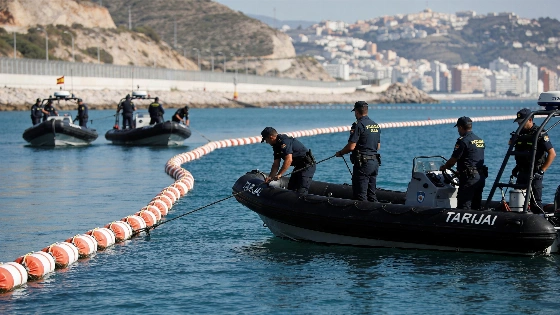
Spanish authorities have set up a 500-metre floating barrier at the Ceuta border. The measure aims to stop sea crossings and enable immediate returns to Morocco. The move follows a Supreme Court decision on border expulsions.
Spanish security forces have installed a 500-metre floating barrier in the waters off the Tarajal border between Ceuta and Castillejos, marking a significant shift in Spain’s approach to irregular migration at its North African enclave. The new barrier, deployed early Saturday by the Ministry of the Interior, is designed to prevent migrants from swimming into Ceuta and to allow for immediate returns to Morocco, in line with a recent Supreme Court interpretation of Spain’s immigration law.
The Supreme Court had previously ruled that so-called “express returns” could not be applied to migrants who entered Ceuta or Melilla by swimming, as the law only permitted such measures for those who crossed established border barriers. However, the court clarified that if physical barriers were present in the sea, the policy could extend to those attempting to bypass these new maritime obstacles.
The barrier itself consists of a pneumatic structure floating on the water’s surface, with a visible height ranging from 30 to 70 centimeters and a submerged section reaching up to one meter. This installation is reinforced by a line of anchored buoys provided by the Spanish Navy, and is supported by a strong presence of maritime units from Salvamento Marítimo, the Guardia Civil, and the Moroccan Royal Navy. According to police sources and on-site observations, these combined efforts have already reduced the number of attempted crossings, with only sporadic incidents reported since the barrier’s deployment.
Government officials argue that the new barrier enables Spain to resume immediate returns of migrants intercepted at sea, without violating the Supreme Court’s restrictions. The installation began at 7:50 a.m. on Saturday, and authorities report that no successful illegal entries have occurred since, as Moroccan forces have intercepted those attempting to cross by water. The move comes after Prime Minister Pedro Sánchez announced plans to reinforce the border in compliance with the court’s decision.
The legal basis for these returns is found in the additional provision of Spain’s immigration law, which allows for the rejection of foreigners detected while trying to overcome border containment elements in Ceuta or Melilla. The Supreme Court’s recent decision, however, made clear that this provision does not apply to those who enter without crossing such barriers—prompting the government to establish new physical obstacles at sea.
The opposition has sharply criticized the measure. Alberto Núñez Feijóo, leader of the Partido Popular, called the floating barrier “ridiculous” and questioned why such steps were not taken earlier. The debate over border security in Ceuta has been ongoing, especially after previous mass crossings and political tensions. For further background on the political fallout from earlier border incidents, see this analysis of government and opposition responses: how the Ceuta border crisis sparked criticism of government action.
Ceuta and Melilla, Spain’s two enclaves in North Africa, have long been focal points for migration from Morocco and beyond. The deployment of physical barriers—both on land and now at sea—reflects ongoing efforts to control irregular entries and manage complex legal and humanitarian challenges at the EU’s southernmost border. The effectiveness and legal durability of these new measures will likely remain under scrutiny as migration pressures and political debate continue.