The government has opened bidding for a €132 million project to prevent flooding in key Valencia municipalities. The works target the La Saleta ravine, which overflowed in 2024. Construction could start before the end of 2026.
The Spanish government has initiated the tender process for a major flood prevention project in the La Saleta ravine, aiming to protect several municipalities in Valencia’s l’Horta Sud after the severe flooding of October 2024. The Ministry for the Ecological Transition is seeking bids for the main phase of the works, with a budget of €132 million including VAT. Companies have until September 22 to submit offers, and according to the Júcar River Basin Authority (CHJ), construction could begin before 2026 concludes.
This intervention is designed to address a longstanding risk for towns such as Aldaia, Alaquàs, Xirivella, Quart de Poblet, and parts of València. The project will create a new hydraulic outlet for floodwaters, channeling them from the ravine toward the Turia River. The main section under tender stretches from Aldaia to the greenway, forming the core of a broader €150 million investment to overhaul the area’s flood defenses.
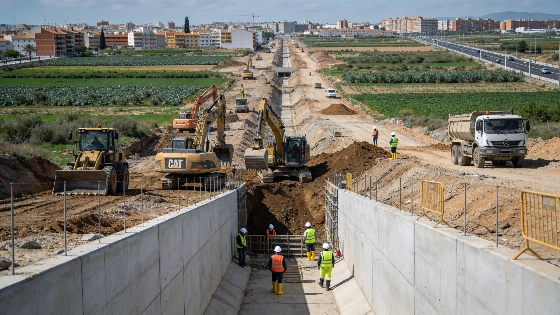
Central to the plan is a four-kilometer underground conduit running beneath northern Aldaia, constructed from reinforced concrete. One of the most technically challenging points will be tunneling under the València-Utiel railway line, which will be achieved using a trenchless method to avoid disrupting train services. After this, floodwaters will continue along a nearly three-kilometer open greenway, integrated into the agricultural landscape, leading toward the new Turia channel.
The overall solution for La Saleta is split into two distinct projects. Alongside the main section now open for bids, a second phase will connect the system to the new Turia channel beneath the V-30 highway. This latter segment, with a budget of around €14 million, has already received technical approval and is expected to be tendered soon. Its complexity stems from the need to safely cross the V-30, requiring close coordination with the Ministry of Transport and Sustainable Mobility’s road division.
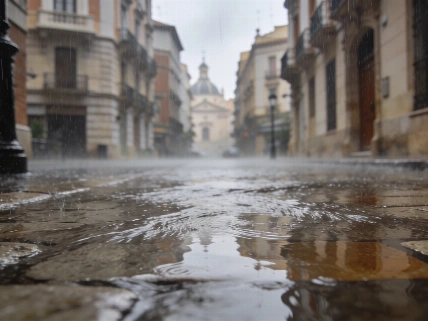
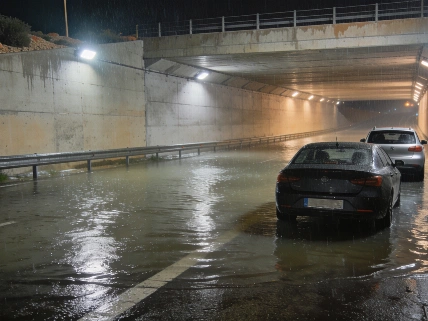
Decades of urban expansion and infrastructure development have left the La Saleta ravine without an effective outlet to the Turia, its natural drainage path. This has led to repeated and sometimes severe flooding in urban areas, most recently during the 2024 storm. The current project is the first large-scale response to this risk in the Poyo basin, and will be complemented by upstream works to further reduce flood volumes, as outlined in the regional resilience and recovery plan for flood-affected areas.
Following the 2024 disaster, the project underwent a full review using new hydraulic studies by the Center for Studies and Experimentation of Public Works (CEDEX). These studies led to an increase in the main conduit’s capacity from 80 to 100 cubic meters per second, with an additional 30 cubic meters per second from the urban section. The system’s first component will be a diversion structure near the CV-410 and Aldaia/Bonaire access points, distributing flows between the CV-410 ditch, the expanded Aldaia urban channel, and the new underground conduit feeding the greenway.
Flood management and infrastructure upgrades have become a growing focus for Spanish authorities, especially after recent extreme weather events. The scale of the La Saleta project reflects a broader trend of investment in climate resilience across the country. For comparison, other regions have faced similar challenges, such as the emergency response to natural disasters in Naples, highlighting the increasing need for robust civil protection measures in southern Europe.
Valencia’s approach combines technical innovation with landscape integration, aiming to balance urban safety and environmental preservation. The works are expected to significantly reduce the risk of future flooding for thousands of residents, while also setting a precedent for similar projects in other vulnerable Spanish regions. The government’s commitment to coordinated planning and investment in hydraulic infrastructure marks a decisive step in adapting to the realities of climate-driven weather extremes.