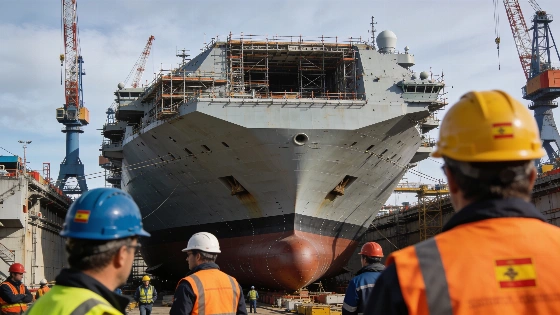
The Spanish Navy is preparing to build two of the largest warships in its history, designed to carry troops, helicopters, and fifth-generation fighter jets. These new vessels, likely to be constructed by Navantia, signal a major leap in Spain’s maritime capabilities.
The Spanish Navy has set in motion plans for a new generation of amphibious assault ships that could redefine the country’s naval strength for decades. According to available details, the project envisions two large Landing Helicopter Dock (LHD) vessels, each potentially displacing up to 40,000 tons—making them the largest warships ever built in Spain.
These ships are being designed to transport a reinforced battalion of marines, along with their vehicles, support equipment, and a significant air wing. The flight deck will be capable of operating up to twenty fifth-generation stealth fighter jets with short takeoff and vertical landing abilities, such as the F-35B, as well as a range of helicopters for tactical transport and attack missions. While the inclusion of these advanced jets is part of the design, their acquisition has not yet been formally confirmed.
The new LHDs are central to the Navy’s Amphibious Projection Concept 2050, a strategic vision that aims to enable Spanish forces to intervene from greater distances and in more contested environments. Each ship will feature a floodable well deck for launching landing craft, fast ship-to-shore connectors, and hovercraft, allowing for simultaneous amphibious operations by sea and air.
Modular Expeditionary Force
The Navy’s proposal goes beyond just two large ships. The future amphibious force will be organized into three modular expeditionary units, each built around an LHD, a lighter mother ship (LXX), and a battalion-sized landing force. This modular approach is intended to provide flexibility for different missions and operational scenarios, enabling continuous deployment cycles without overcommitting resources to a single operation.
One notable feature is the ability to project landing forces from up to 150 nautical miles offshore, reducing the exposure of main vessels to coastal defenses. The composition of each unit can be adjusted based on mission requirements, reflecting a shift toward adaptable, scalable naval operations.
Navantia’s Role and Construction Timeline
Navantia, Spain’s leading shipbuilder, is expected to take the lead in constructing these new LHDs, likely at its Ferrol shipyard. The company previously built the Juan Carlos I, the Navy’s current flagship and a reference point for the new design. Spanish expertise in this field has already been exported to Australia and Turkey, with similar ships based on the Juan Carlos I platform.
The new vessels will expand on this legacy, offering greater capacity for aircraft, troops, and landing craft. Construction could begin as early as 2028, with the ships entering service in the following decade, pending completion of design, contracting, and testing phases. As with many large-scale defense projects, specific dates remain provisional.
Size and Capabilities
Current estimates for the new LHDs’ displacement range from 30,000 to 40,000 tons. The higher figure would allow for the full integration of a reinforced battalion, vehicles, and up to twenty stealth fighters, while the lower estimate would still surpass the capabilities of the Juan Carlos I. Final specifications will depend on the chosen design, air wing size, and operational requirements.
Until the design is finalized, these figures should be seen as indicative of the project’s ambition rather than fixed targets. The Navy’s plans reflect a broader trend among NATO allies to modernize amphibious and expeditionary capabilities in response to evolving security challenges.
While the focus is on military innovation, Spain’s investment in advanced naval technology also highlights the country’s growing role in European defense industries. The scale of the project is reminiscent of other major infrastructure initiatives, such as the launch of unique attractions near Madrid, like the water coaster featured at Aquopolis Villanueva de la Cañada, which was recently covered in a report on new developments in Spain.
As the Spanish Navy moves forward with these plans, the coming years will determine how these new ships reshape the country’s maritime presence and its ability to respond to future crises.