Millions in Spain are set to witness a total solar eclipse, the first in 121 years. Authorities brace for record travel, safety risks, and economic impact as the phenomenon crosses the peninsula.
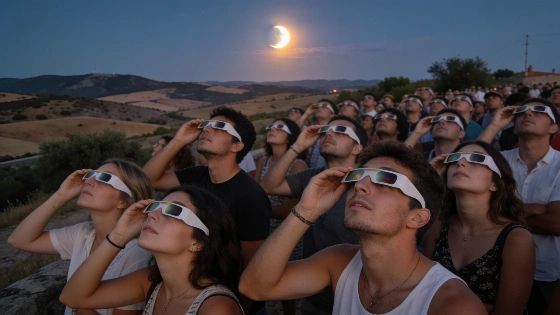
Spain is on the verge of experiencing its first total solar eclipse in more than a century, with the rare astronomical event set to darken skies from Galicia to the Balearic Islands. The eclipse, expected to reach its peak around 20:30, will be fully visible across much of northern Spain, drawing millions of residents and tourists to key viewing locations. The phenomenon, caused by the alignment of the Earth, Moon, and Sun, is notable not just for its rarity in Spain—last seen 121 years ago—but also for the unprecedented logistical and safety challenges it brings.
Authorities have launched a large-scale operation to manage the surge in travel and ensure public safety. The Ministry of Science and Universities, citing data from the Dirección General de Tráfico (DGT), anticipates between 400,000 and 1.5 million additional journeys as people move toward the path of totality. Over 24,000 Civil Guard officers and 9,400 National Police agents will be deployed to monitor traffic, prevent accidents, and maintain order. Officials urge travelers to plan carefully, avoid stopping on road shoulders, and carry supplies in case of delays, referencing past incidents in the United States where similar events led to severe congestion and communication outages.
Health and environmental risks are also a priority. The government strongly advises against looking at the Sun without certified eclipse glasses, warning of potential eye damage. With the event coinciding with a period of high temperatures and drought, the risk of wildfires is acute. The Ministry for Ecological Transition has issued strict guidelines: no open flames, no parking on dry vegetation, and keeping emergency access routes clear. These measures aim to prevent incidents as crowds gather in rural areas, many of which are typically sparsely populated but now face an influx of visitors seeking clear skies.
The economic impact is already visible. According to a report from the Ministry of Economy, Commerce and Enterprise, the regions within the path of totality are expected to receive nearly 447,000 extra visitors this week, generating an estimated €347.6 million. Hotel and restaurant bookings have surged, with accommodation prices in cities like Soria and Zaragoza multiplying several times over recent months. Local authorities and municipalities have designated hundreds of official viewing points, many equipped with safety personnel and distributing protective eyewear.
The eclipse will begin in the northwest around 19:30, with totality lasting up to 1 minute and 50 seconds in the best locations. The first areas to experience complete darkness will be Cabo de Peñas in Asturias and Estaca de Bares in A Coruña, just after 20:26, while the last will be Faro de la Mola in Formentera at 20:33. For precise timings, the Instituto Geográfico Nacional (IGN) offers an online tool to check local eclipse schedules. The Ministry of Science, Technology and Universities has also launched a dedicated website with a simulator for eclipse viewing conditions.
This eclipse marks the first time Spaniards can observe a total solar eclipse using modern protective glasses, developed in the 1970s. These glasses, certified to ISO 12312-2, are essential for safely viewing the Sun except during the brief period of totality, when the solar corona becomes visible. Removing the glasses at the wrong moment can cause serious eye injury, so knowing the exact duration of totality at each location is critical.
Adding to the astronomical significance, the eclipse coincides with the peak of the Perseids meteor shower, offering a rare double spectacle. According to EL PAÍS, the last time both phenomena occurred together was in the era of the Neanderthals. For those unable to witness this event, Spain is set to experience two more major eclipses in the coming years: a total solar eclipse in the south in 2027 and an annular eclipse in 2028.
Solar eclipses are rare in any given location, typically occurring somewhere on Earth every 18 months, but seldom passing directly overhead. The current event has transformed remote Spanish villages into temporary hubs of activity, with both regular holidaymakers and eclipse chasers converging in search of the best vantage points. The combination of scientific interest, logistical complexity, and economic opportunity makes this eclipse a landmark event for Spain in 2026.