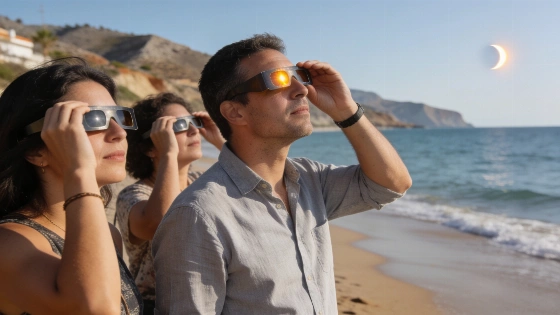
Spain will witness a total solar eclipse in August 2027, with the path of totality crossing key southern provinces. An annular eclipse will follow in January 2028. Both events are expected to draw large crowds and require careful planning.
Spain is set to become a focal point for astronomical events over the next two years, as the country prepares for a total solar eclipse in August 2027 and an annular eclipse in January 2028. The upcoming eclipses are expected to attract millions of visitors, especially to the southern regions where the path of totality will be most visible.
The next major event will occur on 2 August 2027, when a total solar eclipse—already dubbed the 'eclipse of the century' due to its exceptional duration—will cross the south of Spain. The shadow of totality will move from west to east, passing over Ceuta, Melilla, most of Cádiz, large parts of Málaga, and the southernmost areas of Granada and Almería. In these locations, the period of darkness will last up to nearly five minutes, with Ceuta experiencing four minutes and 48 seconds of totality, and Melilla four minutes and 34 seconds. Cádiz will see two minutes and 45 seconds, while Málaga will have one minute and 48 seconds. Elsewhere in Spain, the eclipse will be partial, but even in those areas, at least 70% of the sun will be obscured.
Interest in these events is already high, following the recent total solar eclipse that drew crowds across the country. According to the Instituto Geográfico Nacional (IGN), the 2027 eclipse will occur around 10:50 in the morning, when the sun is high enough to allow for optimal viewing conditions. However, the narrow path of totality means that the best viewing spots will be limited, and authorities expect significant congestion in these areas. Those planning to travel to the south for the event are advised to make arrangements well in advance.
For those considering international travel, Egypt will offer the longest duration of totality, with the city of Luxor experiencing six minutes and 23 seconds of darkness. Other notable locations include Tangier in Morocco, where the eclipse will last four minutes and 51 seconds, and Lampedusa in Italy, with two minutes and 56 seconds. Some eclipse chasers are expected to head to Saudi Arabia, where Jeddah and Mecca will see totality for nearly six and five minutes, respectively.
Before the 2027 solar eclipse, Spain will also witness a partial lunar eclipse on the night of 28 August 2026, visible across the entire country. This event will be safe to observe with the naked eye and does not require any special equipment. The lunar eclipse will serve as a prelude to the more dramatic solar events to follow.
The final chapter in this series of astronomical phenomena will be the annular solar eclipse on 26 January 2028. During this event, the moon will pass in front of the sun but, being at its farthest point from Earth, will not cover it completely. Instead, a 'ring of fire' will be visible in the sky. The annular eclipse will cross Spain from southwest to northeast late in the afternoon, affecting regions such as Andalucía, southern Extremadura, Castilla-La Mancha, parts of Madrid, Aragón, Murcia, Comunidad Valenciana, sections of Cataluña, and the westernmost Balearic Islands. In the rest of the country, the eclipse will be partial. Unlike the total eclipse, at no point during the annular eclipse will it be safe to look at the sun without proper eye protection, as the visible ring remains direct sunlight.
These rare astronomical events are expected to have a significant impact on tourism and local infrastructure, particularly in the regions along the path of totality. The influx of visitors will require careful coordination by local authorities to manage crowds and ensure safety. As seen during previous eclipses, such as the one covered in reports on the recent total solar eclipse in Spain, public interest in these phenomena remains exceptionally high.
Solar and lunar eclipses have long fascinated both scientists and the general public. In Spain, the upcoming events offer a rare opportunity to observe these phenomena without leaving the country. The 2027 total solar eclipse, in particular, stands out for its duration and the regions it will cross, making it one of the most anticipated astronomical events of the decade. The annular eclipse in 2028 will provide a different spectacle, with the characteristic ring of sunlight visible across much of the peninsula. Both events highlight the importance of preparation, both for safe viewing and for managing the expected surge in visitors to the affected areas.