On August 12, 2026, Spain will witness its first total solar eclipse in over a century, followed by the peak of the Perseid meteor shower. Experts urge careful planning, as the eclipse will occur at sunset and require unobstructed views to the west.
As the evening of August 12, 2026 approaches, anticipation is building across Spain for a rare astronomical event: a total solar eclipse, the first visible from the Iberian Peninsula since 1912. According to meteorologist Roberto Brasero, the spectacle will unfold just before sunset, making the choice of viewing location more critical than ever.
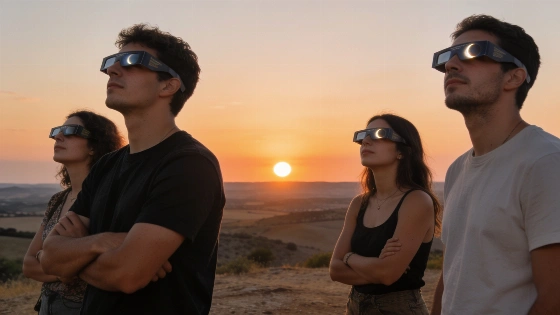
Brasero, speaking to Diario AS, emphasized that only those with a completely clear view to the west will be able to witness the moment when the Moon fully covers the Sun. Even a single tree or building could block the sightline at the crucial moment. The Instituto Geográfico Nacional (IGN) confirms that the Sun will be extremely low on the horizon during totality, with its altitude ranging from 12 degrees in A Coruña to just 2 degrees in Palma.
Timing and Visibility
The eclipse will not occur simultaneously across Spain. In A Coruña, the maximum eclipse is expected at 20:28, with the Sun 12 degrees above the horizon. In Burgos, the peak will be at 20:29 with an altitude of 8 degrees, while in Palma, the Sun will sit barely 2 degrees above the horizon at 20:32. The total phase will last between 76 and 104 seconds, depending on location. Outside the narrow path of totality, only a partial eclipse will be visible, and eye protection must be worn at all times.
Essential Safety Measures
Brasero issued a clear warning: “Do not look directly at the Sun.” Only certified eclipse glasses with the EN ISO 12312-2:2015 standard and CE marking are considered safe. Regular sunglasses, smoked glass, CDs, or improvised filters offer no real protection. The IGN has coordinated the distribution of two million free eclipse glasses across Spain to ensure safe viewing. Observers should only remove their glasses during the brief period of totality, and only if they are within the path where the Sun is completely obscured. Cameras, binoculars, and telescopes require professional solar filters fitted in front of the lens; using eclipse glasses alone with optical devices can cause serious eye injury.
Weather and Planning
Weather conditions could make or break the experience. Brasero highlighted the risk of summer storms, evolving clouds, and coastal fog, especially in northern regions. The Spanish meteorological agency AEMET will issue daily cloud cover forecasts starting August 7, helping observers choose the best possible location. The IGN recommends avoiding last-minute travel and selecting a nearby site with a clear western horizon. Special traffic measures are being prepared to manage the expected influx of eclipse watchers.
The Night of the Perseids
Once the Sun sets, the sky will offer a second show: the peak of the Perseid meteor shower. The best viewing window will be between 4:00 and 6:00 a.m. on August 13, though activity will be visible from 23:00 onwards. The new moon on August 12 will ensure dark skies, making this one of the most favorable years for meteor watching. The IGN advises heading away from artificial lights, finding a wide field of view, and allowing your eyes to adjust to the darkness for the best experience.
With careful preparation and attention to safety, August 12 promises to be an unforgettable night for skywatchers across Spain.