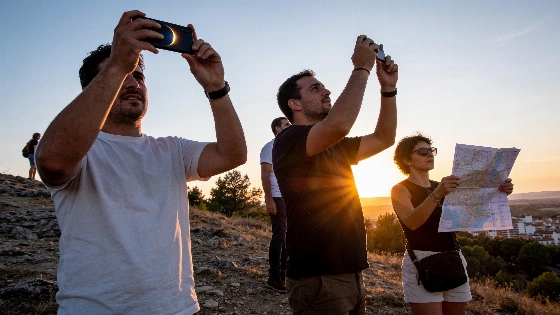
Spain faces a rare total solar eclipse in August 2026. Authorities and apps offer tools to check if your location is ideal. Late timing and obstacles may block the view. Official viewing points and safety measures are in place.
With Spain set to witness a total solar eclipse on August 12, 2026, the question of where and how to see the phenomenon has become urgent for residents and visitors. The eclipse will only be fully visible within a narrow path, making location checks essential. The official IGN Eclipses app, available for both iPhone and Android, allows users to confirm if their chosen spot falls within the path of totality. By selecting the eclipse event in the app and pinpointing a location on the map, users can instantly see whether the eclipse will be total at that site, along with the exact start time and duration.
Timing is critical: the total phase is expected to begin around 20:30, when the sun will be low on the horizon. This increases the risk that trees, buildings, or even small hills could block the view. The IGN website also offers a desktop version for those planning ahead. For those unsure about local visibility, the Ministry of Science provides an official augmented reality viewer that uses a phone’s camera to show precisely where the sun will be during the eclipse’s peak. This tool helps users identify potential obstacles and adjust their plans accordingly.
Popular astronomy apps such as Star Walk, Sky Tonight, and Sky Guide can also help check the sun’s position at the crucial moment. However, experts recommend visiting the chosen location in advance to avoid last-minute surprises. As the event approaches, traffic congestion and road closures are likely, especially near popular viewing areas. For those unable to check the site in person, the ShadeMap website offers a detailed shadow overlay that factors in buildings and trees, providing a more accurate prediction of which areas will remain sunlit during the eclipse.
For anyone hesitant to select their own spot or unfamiliar with the region, local authorities and autonomous communities have designated official eclipse viewing points. These locations are equipped with safety and emergency services, and in many cases, visitors can obtain protective glasses on site. The newspaper EL PAÍS has published a map of these official viewpoints, making it easier for the public to plan their experience safely and efficiently.
Safety remains a top concern. As highlighted in recent coverage of eclipse safety protocols, removing protective glasses even briefly can cause lasting eye damage. The rules for safe viewing differ between total and partial eclipse zones, and authorities urge everyone to follow official guidance strictly.
The 2026 eclipse is a rare event for Spain, with the next opportunities not expected for decades. The IGN Eclipses app and official resources are designed to help residents and visitors make the most of this unique moment. Planning ahead, checking for obstacles, and using official viewing points can ensure a safe and memorable experience. As the date approaches, staying informed about local arrangements and safety recommendations will be crucial for all hoping to witness the spectacle.