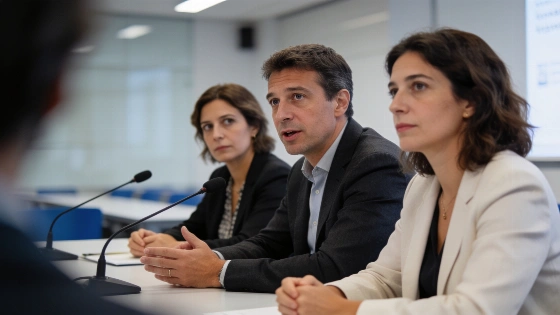
Spain's public health leaders met to examine the system's next challenges. The debate focused on regional responsibility, national coordination and the tests that will shape the system's resilience.
Pedro Gullón, Spain's director general of Public Health and Health Equity, joined regional officials and medical specialists at a meeting on the future of public health. The roundtable examined leadership by autonomous communities and coordination between administrations. Those were the main pressure points.
The event was titled 'Retos y necesidades de la salud pública en España. Liderazgo autonómico y resiliencia del sistema sanitario'. It brought together officials from the national and regional levels with specialists in prevention medicine, vaccination, cardiology, pneumology and geriatrics.
No single reform came out of the meeting. The discussion focused instead on preparedness for new health threats and on how responsibilities are divided between administrations. Spain's national authorities set common strategies. Autonomous communities manage and deliver much of healthcare and public-health activity.
In Spain, the Interterritorial Council of the National Health System (CISNS) is a central forum where the Ministry of Health and autonomous communities coordinate vaccination and other public-health recommendations before regions implement them locally.
That division of responsibility sits at the centre of the debate. Elena Andradas, director general of Public Health for the Community of Madrid, and Ángel Gil, catedrático of Preventive Medicine and Public Health at URJC, took part. Gil also directs the Cátedra de Innovación y Gestión Sanitaria de la URJC. Santiago de Quiroga, president of Fundamed, was also there.
Regional officials showed how the system works beyond the central administration. Antonia Elena Esteban represented the Government of the Balearic Islands. Eva Martínez attended for the Government of La Rioja. Yolanda Márquez represented the Junta de Extremadura. Cristina Granda took part for the Junta de Castilla y León.
The panel's size was deliberate. The Ministry of Health keeps responsibility for strategic coordination and common policy. Autonomous communities organise services and carry out many public-health measures. The Ministry and the CISNS set the national framework. Regional administrations decide much of the pace, local coverage and logistical delivery.
That is where the system gets tested.
Autonomous communities are launching their 2026 seasonal vaccination campaigns according to their own schedules. The example shows why national goals for influenza and COVID vaccination depend on regional organisation, logistics and the ability to maintain comparable access across territories.
Vaccination and clinical prevention were discussed alongside institutional management. Jaime Jesús Pérez, president of the Asociación Española de Vacunología (AEV), joined Luis Rodríguez, former president of the Sociedad Española de Cardiología (SEC) and head of the Cardiology Service at the Complejo Hospitalario Universitario de Toledo.
Jorge del Diego, a senior adviser at the Dirección General de Salud Pública y Equidad del Ministerio de Sanidad, also participated. Carlos Almonacid, head of Pneumology at Hospital Universitario Puerta de Hierro Majadahonda, represented SEPAR on the FACME board.
The public-health debate also connects with respiratory concerns covered in earlier coverage. The roundtable took a wider view. Its question was how Spain can organise the system before new threats appear, rather than wait until pressure has built.
Influenza and COVID vaccination show the same split in responsibility. National authorities agree common recommendations. Regional authorities organise the campaigns, work to reach people and set the pace of delivery.
Esther Martínez brought experience from geriatric care and vaccination. She is a geriatrician, a member of the vaccine and infections group of the Sociedad Española de Geriatría y Gerontología (SEGG), and head of studies at the Geriatrics Teaching Unit of Hospital de la Santa Creu de Tortosa. José Javier Castrodeza, catedrático of Preventive Medicine and Public Health at the Universidad de Valladolid, moderated the second session.
Fundamed and the Cátedra de Innovación y Gestión Sanitaria de the Universidad Rey Juan Carlos organised the event with support from CSL Seqirus. Guillermo Fernández reviewed it in a video.
The meeting put the structure of public health at the centre of the discussion. Resilience depends on more than medical expertise. National and regional authorities must be able to act as one system when a new threat arrives.
At the end of September 2026, the Ministry of Health was also discussing the expansion of pharmacological abortion into primary care with autonomous communities. That issue shows that the practical division of responsibilities remains active. Regional governments are updating long-term health plans as well. Those plans include measures to integrate mental health.
The challenge is practical. Spain needs coordination, common standards and stable administration if it is to respond to new threats and maintain comparable access across regions.