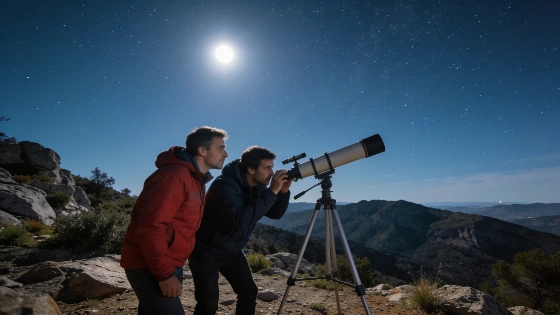
Spain highlights five certified Starlight sites for lunar observation. These locations promise clear night skies and minimal light pollution. The initiative coincides with the International Observe the Moon Night, promoted by NASA.
Spain is drawing attention to its clearest night skies as the International Observe the Moon Night approaches. Five destinations with Starlight certification are in focus this year. The event, organized by NASA and set for September 19, highlights places where light pollution is minimal and lunar craters are visible to the naked eye. NASA schedules the event to match the Moon's first quarter, when surface details stand out for observers around the world.
La Palma in the Canary Islands is known for its exceptional clarity. The Mirador de Llano del Jable and the Mirador Astronómico del Roque de los Muchachos both offer wide views above the clouds and access to major telescopes, including the Gran Telescopio Canarias. The island's clean air and low humidity make it possible to see lunar features without any equipment. According to the Instituto de Astrofísica de Canarias, Roque de los Muchachos is mainly a research site, so public access to some telescopes is limited.
The Starlight certification in Spain is not just a label for tourism, but an official recognition of territories with exceptionally low light pollution, verified by rigorous standards.
Inland, the Sierra de Gredos in Ávila holds the Cielo Oscuro Starlight certification, which means excellent visibility. The Plataforma de Gredos in San Juan de Gredos is a popular spot for amateur astronomers, easy to reach by car and known for its open skies. The Starlight Foundation and local tourism offices regularly mention the area's certified dark-sky status and its efforts to protect natural nightscapes.
Teruel’s Comarca de Gúdar-Javalambre is one of Europe’s top stargazing areas, with both Starlight Reserve and Tourist Destination status. All 24 municipalities have an astronomical viewpoint, but Pico del Buitre, home to the Observatorio Astrofísico de Javalambre, stands out. The observatory itself is for research, but the surrounding area offers some of the cleanest air on the peninsula for setting up personal telescopes or binoculars. Official Starlight project documents note Gúdar-Javalambre's very low artificial light, making it a reference point for astrotourism in Spain.
Further south, Los Pedroches in Córdoba is the largest Starlight Reserve on the peninsula. Seventeen municipalities here are free from light pollution, with accessible sites like the Mirador del Campo de Fútbol in Dos Torres and the Mirador de la Dehesa in Cardeña, which sits inside the Parque Natural de la Sierra de Cardeña y Montoro. These locations combine telescope facilities with oak woodlands under the stars.
The International Observe the Moon Night on September 19, 2026, is a global initiative led by NASA, inviting participants from all continents to join both in-person and at-home lunar observations. Spain leverages this event to promote its certified dark-sky destinations, aligning with the international focus on lunar surface features during the Moon's first quarter.
— NASA
In Catalonia, the Parque Nacional de Aigüestortes y Lago de San Mauricio, established in 1955, is the region’s only national park and a recognized Starlight Tourist Destination. Its high elevation means dark skies and clear views of the Moon above the Pyrenees. The Ermita de Sant Quirc de Durro in Vall de Boí is a favorite viewpoint, with educational panels for constellation spotting and Romanesque architecture nearby.
The choice of these five sites reflects a growing interest in astrotourism in Spain, where certified dark-sky areas are valued for both science and sustainable travel. The Starlight Foundation’s strict certification process requires tight controls on artificial lighting, helping to preserve natural nightscapes. As Spain invests in protecting its night skies, these destinations attract astronomers, support local economies, and raise awareness about light pollution. The country’s efforts make it a leader in European astrotourism, offering a rare chance to experience the night sky in its natural state.