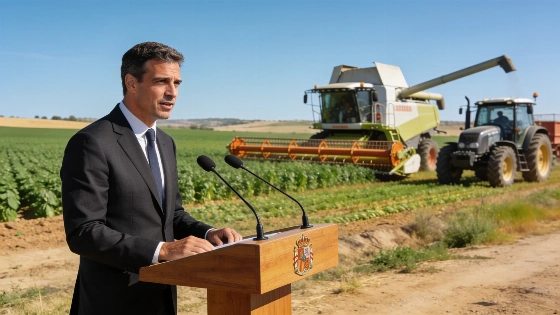
Pedro Sánchez has announced a National Fertilizer Plan for early 2027. Over €1.1 billion in aid is already mobilized for Spain’s primary sector. The move aims to reduce dependency and stabilize food production.
The Spanish government is set to introduce a National Fertilizer Plan by the first quarter of 2027, aiming to strengthen domestic production and reduce reliance on external suppliers. President Pedro Sánchez revealed the initiative during an event in San Martín de la Vega, Madrid, highlighting the urgency created by ongoing disruptions in the Middle East and the closure of the Strait of Hormuz, which have directly affected fertilizer imports and, consequently, the agricultural sector.
As part of the immediate response, the government has published a list of 425,000 beneficiaries who will receive support for fertilizer purchases, with more than €600 million allocated to this measure. This fund was recently increased by an additional €165 million, bringing the total aid for fertilizer acquisition to €665 million. In total, Spain has mobilized over €1.1 billion in support for the primary sector to counteract the effects of the crisis, a figure that more than doubles the European average for similar aid packages.
The new plan is structured around three main priorities: advancing precision agriculture through technologies such as drones and agronomic monitoring tools; reinforcing Spain’s strategic autonomy by reducing dependence on natural gas for fertilizer production; and increasing price transparency with a dedicated market information system to anticipate and respond to price fluctuations. An interministerial working group is already operational, and the government has committed to ongoing dialogue with all relevant administrations and stakeholders to ensure the plan is comprehensive and effective.
In addition to the new measures, existing support mechanisms remain in place. The latest Royal Decree-Law has nearly doubled per-hectare subsidies, maintained the 20-cent per litre discount on agricultural and fishing diesel, and secured up to €300 million in financing through the ICO-MAPA-SAECA line. These steps are designed not only to address the current crisis but also to build resilience against future shocks, supporting a transition toward more sustainable and efficient agriculture in line with European fertilizer policy objectives.
Minister of Agriculture, Fisheries and Food, Luis Planas, emphasized the importance of improving fertilizer efficiency, promoting controlled organic fertilization, and investing in research and innovation. The plan also encourages the development of bio-stimulants and techniques that reduce dependence on fossil fuels, further supporting Spain’s goal of greater self-sufficiency in agricultural inputs.
Spain’s agricultural sector, which ranks fourth in export volume within Europe and seventh globally, is recognized for its commitment to innovation and the growing participation of women, who now account for nearly 30% of employment in the sector. The government’s latest actions are intended to support the nearly 1.5 million farmers and livestock breeders who form the backbone of rural Spain.
While the focus is now on agricultural resilience, Spain’s broader approach to crisis management has also been visible in other sectors. For example, during the launch of San Fermín 2026 in Pamplona, authorities prioritized emergency services and public health in response to record crowds and extreme heat, as detailed in this report on the San Fermín festival’s new safety measures.
These developments underscore the government’s strategy of combining immediate relief with long-term structural reforms. By investing in technology, supporting innovation, and fostering collaboration across sectors, Spain aims to secure its food supply and strengthen its position as a leading agri-food power in Europe and beyond.