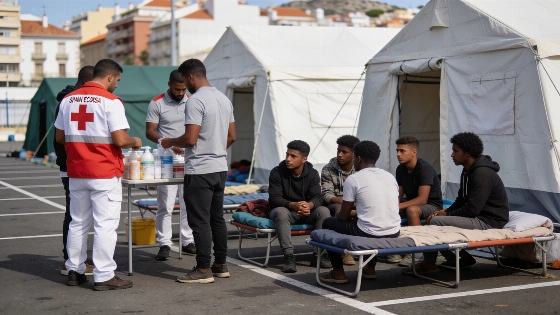
The Spanish government will create 1,500 places for migrants in Ceuta. Four sites are being prepared after a surge in arrivals. Local and central authorities remain divided over priorities and locations.
The Spanish government has confirmed it will open four new facilities in Ceuta to accommodate up to 1,500 migrants, following a mass entry into the enclave more than two weeks ago. The announcement, made by Minister of Migrations and Inclusion Elma Saiz, comes amid mounting pressure to address the situation of hundreds of people still sleeping outdoors in the city’s streets and beaches.
Saiz, speaking at the Government Delegation in Ceuta, emphasized the need for institutional cooperation to restore order quickly. The move follows sharp criticism from Ceuta’s president, Juan Jesús Vivas, who has openly challenged the central government’s handling of the crisis. The tension between local and national authorities has grown as both sides debate how and where to house the new arrivals.
The four sites include one municipal property—the Embolsamiento parking area in Loma Colmenar—offered by the city government, and three locations provided by the central administration: the equestrian center near the Centro de Estancia Temporal de Inmigrantes (CETI), the former football field at the cavalry barracks, and the El Guano area. These spaces are intended for those who entered during the recent surge and have spent over two weeks without shelter.
Despite the new plan, the government has not specified whether its priority is to return migrants to Morocco or process asylum requests. Saiz stated only that all actions would comply with current legal standards. The central government is responsible for adult migrants, while the city manages unaccompanied minors.
Estimates suggest around 80,000 people entered Ceuta during the mass crossing, with approximately 70,000 returned by Spanish security forces in the first weekend. Since then, about 600 more have left voluntarily. However, the exact number of migrants still in Ceuta remains unclear. The city has already begun relocating a group of girls and teenagers previously sheltered by the El Príncipe neighborhood association, one of Spain’s most disadvantaged areas. The National Police have transferred unaccompanied minors to two refurbished industrial warehouses, offering a total of 500 bunk beds.
Negotiations over shelter locations have exposed friction between the city and Madrid. Vivas opposed using central urban sites or the port, citing complaints from local residents. The adequacy of the four new facilities is also in question, as it is uncertain whether they will be enough to house everyone currently living in makeshift camps, such as the one on El Trampolín beach.
In recent days, frustration among migrants has grown. On Sunday, dozens of Maghrebis refused food provided by the Red Cross, demanding asylum from the central government. Many argue their legal situation differs from that of sub-Saharan migrants, whose countries of origin may make them more likely to receive asylum. During a sit-in, closely monitored by National Police, the group chanted, “Todos los migrantes son iguales.”
This situation in Ceuta highlights the ongoing challenges Spain faces in managing migration flows and balancing humanitarian needs with legal and political pressures. The debate over how to house and process new arrivals echoes broader tensions seen in other Spanish regions, where issues of inequality and social integration remain prominent. For example, recent analysis of Barcelona’s metropolitan area has shown that while diversity is increasing, deep divides in income and housing persist, as detailed in this report on urban inequality in Barcelona. The developments in Ceuta now add another layer to Spain’s complex migration landscape, with both immediate and long-term implications for local communities and national policy.