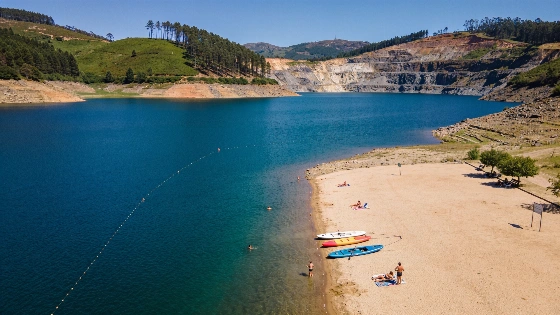
A former lignite mine in As Pontes, Galicia, was transformed into a vast lake after being filled with 547 billion liters of water. Fourteen years later, its beach has earned Blue Flag status for 2026, highlighting a remarkable shift from industrial site to public recreation area.
In January 2008, the vast pit left by the As Pontes lignite mine in Galicia began a carefully managed transformation. Over four years, engineers filled the site with 547 million cubic meters of water—equivalent to 547 billion liters—creating what is now one of the largest artificial lakes in Europe. By April 2012, the lake reached its stable level, and today, its shoreline is recognized among Spain’s top beaches, set to retain Blue Flag status in 2026.
The As Pontes mine, which operated from the 1970s until late 2007, supplied lignite to a nearby power plant. According to regional authorities, more than 261 million tons of lignite were extracted during its final three decades, with nearly 700 million cubic meters of overburden moved. The end of mining left a massive void and an extensive external spoil heap, both requiring significant environmental rehabilitation.
From Extraction to Restoration
Restoration efforts began well before the last excavators left. In the 1980s, Endesa, the company operating the mine, launched a program to stabilize soils, restore topsoil, and plant grass, shrubs, and trees. By 2006, the revegetation of the spoil heap was complete, setting the stage for the next phase: transforming the mine pit into a lake.
Engineering a New Landscape
Filling the pit was a complex process. Environmental authorities approved a plan in 2005 that combined runoff, nearby streams, and water diverted from the Eume River. A main canal nearly six kilometers long, along with additional channels, directed water into the basin. The project also included a natural outflow to the Carracedo River, ensuring the lake would maintain water quality and avoid stagnation.
Simply letting the pit fill naturally was not an option. The plan required strict controls to prevent acidity, including the creation of six reed-filled wetlands, slope revegetation, and a lime-based neutralization system. Water chemistry, slope stability, and potential contamination were closely monitored throughout the process. By 2012, the lake had reached its planned volume, and since then, it has operated with a controlled inflow and overflow system.
Two Worlds Below the Surface
Despite the scale of the restoration, the lake’s waters remain stratified. Scientific studies have identified two distinct layers separated by a chemical boundary: the upper layer is oxygenated with a slightly acidic pH, while the deeper zone is more acidic and lacks oxygen. This separation limits mixing and preserves different chemical conditions at various depths. As a result, only the surface waters are suitable for swimming and recreation, which is reflected in the Blue Flag assessment criteria.
From Industrial Past to Public Space
The public beach at As Pontes opened in 2012, offering 400 meters of coarse sand and sheltered swimming areas. The surrounding landscape features shallow zones, islands, and artificial cascades designed to support aquatic life. Endesa reports that the restored area now includes 1,200 hectares of meadows, shrubland, forest, and ponds, supporting more than 239 vertebrate species. The transformation has reconnected the site with the local community, providing space for recreation, water sports, and environmental education.
Today, the lake is a hub for kayaking, sailing, windsurfing, and other aquatic activities. Its continued Blue Flag status depends on maintaining strict environmental and safety standards. The project stands as a rare example of how a post-industrial landscape can be repurposed for public benefit without erasing its history.
While the environmental legacy of decades of mining cannot be fully erased, the As Pontes lake demonstrates what is possible when restoration is planned from the outset. For visitors to Galicia, the site offers a unique blend of natural beauty, recreation, and a glimpse into the region’s industrial past.