Emergency Evacuation of MV Hondius in Tenerife: 23 Countries and Military Involved. Spanish authorities have launched an urgent evacuation of MV Hondius passengers following a hantavirus outbreak. The operation involves 23 countries and the military. Most foreign nationals have already been sent home, while Spanish citizens remain in quarantine.
An unprecedented emergency evacuation operation began Sunday in southern Tenerife, after a deadly outbreak of Andes hantavirus was detected on the cruise ship MV Hondius. Over four days, alarm surrounding the vessel traveling from the Atlantic spread beyond the Canary Islands to dozens of countries: there were citizens from 23 nations on board, and the virus has officially claimed three lives and infected six more.
Large-scale coordination
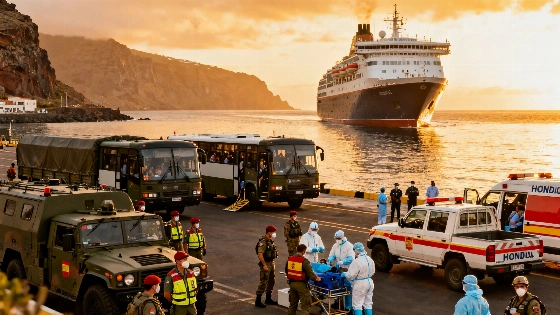
According to Interior Minister Fernando Grande-Marlaska, Spanish authorities mobilized 358 security service personnel and UME military units to escort passengers to the airport. By Sunday evening, seven foreign airplanes had landed in Tenerife to collect their citizens. The remaining 14 Spanish nationals were placed in quarantine at Gómez Ulla Hospital in Madrid. Health Minister Mónica García emphasized that such a massive international evacuation is unprecedented, but all stages are under strict security control.
Decisions and controversies around the port
The operation was complicated not only by epidemiological risks, but also by logistics. At the insistence of regional authorities, the MV Hondius was not allowed to dock but left at anchor in the waters of the Granadilla port. This decision sparked debate: experts noted that the depth and weather conditions in this area were not ideal for such maneuvers, and transferring passengers in open water could have created additional hazards. In the end, the vessel was placed in a sheltered part of the port, with passengers transported in small groups by zodiacs, strictly according to their flight arrival schedules.
On-site authorities and service response
Several ministers were directly involved in the operation and personally traveled to the Canaries to oversee the situation. Buses provided by the shipowner were used to transport those potentially infected, under military escort. At the same time, regional health services prepared to receive possible serious patients, in case any passengers were unable to fly due to health conditions. As reported by EL MUNDO, by the start of the evacuation, none of the passengers had developed new symptoms of illness.
Context and consequences
The situation with MV Hondius has drawn international attention and served as a reminder of the risks of new epidemics. Spain found itself at the center of a complex logistical challenge, which had to be addressed amid pressure and concerns from local residents. Earlier, authorities had already strengthened security measures at the port of Tenerife and isolated disembarkation zones to minimize the risk of the virus spreading — more details on these steps can be found in the article about the lockdown of the port following the arrival of MV Hondius.