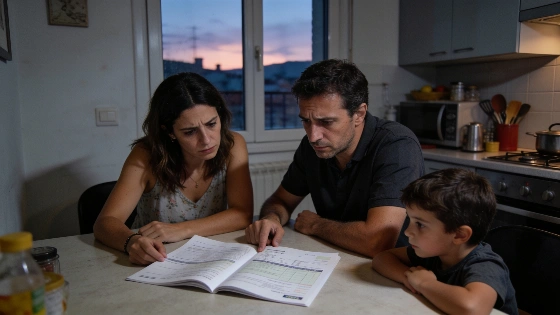
Spanish households on the PVPC tariff saw their August electricity bills jump to 79.75 euros, up 17 percent from last year. The rise is driven by soaring wholesale prices and the end of key tax breaks, leaving families exposed to volatile energy costs.
Spanish families on the PVPC tariff saw their electricity bills climb to 79.75 euros in August, the sharpest annual jump since the 2022 energy crisis. The Organización de Consumidores y Usuarios (OCU) calculated this figure for a typical home with 4.6 kW contracted power and 292 kWh monthly use. That’s 12.01 euros more than last August and nearly 2 euros higher than July.
This isn’t a minor fluctuation. OCU points to a wholesale market price of 118.25 euros per megawatt hour—a 13 percent increase in just one month. Only August 2022, during Europe’s energy panic, saw higher prices. The main drivers: record summer heat, higher demand, and less wind and nuclear generation. Solar output stayed strong, but as evening demand rose, utilities turned to gas, which has become more expensive due to instability in the Middle East. According to Spanish business media, the August 2026 average pool price of 118.24–118.25 €/MWh is the highest since February 2023 and about 70% above last year’s level.
From June 1, 2026, Spain reinstated the standard 21% VAT rate on electricity, replacing the temporary 10% rate that had helped cushion bills during the energy crisis.
For many households, the impact is immediate. OCU’s model bill is up 17.73 percent year-on-year, but the real effect depends on how much each family uses. Running air conditioning through hot nights or using inefficient settings can push costs even higher. The 79.75 euro figure is only a benchmark; actual bills vary with usage and contract terms. In some cases, August bills reached 88.81 euros for similar consumption, showing how taxes and other charges add up, as confirmed by OCU and other consumer groups.
The government’s emergency tax breaks on electricity are also ending. The Real Decreto-ley 18/2026 would have extended the reduced 10 percent VAT and 0.5 percent special electricity tax into September, but only if July’s electricity CPI was at least 15 percent higher than last year. OCU confirms that threshold wasn’t met, so the relief won’t apply to September bills covering August use. The group is now urging a review of these strict requirements, arguing that fiscal support should respond more flexibly to market shocks. According to official sources, the special electricity tax for August and September 2026 is set at 5.11269632%, as published by the Agencia Tributaria.
OCU’s advice is direct: don’t rely on temporary discounts or headline rates. Instead, compare annual costs across providers and consider fixed-rate tariffs for at least a year to protect against further price swings. Still, fixed rates aren’t a universal fix—results depend on each household’s usage, contract details, and market trends. Vulnerable families should also check if they qualify for the 2026 social electricity bonus, which is separate from the now-expired tax reductions.
Since 2026, the PVPC tariff calculation includes a 55% weighting for futures market prices, reducing the direct impact of daily spot price swings but still leaving bills exposed to broader market volatility. This structural change was introduced to stabilize consumer costs, but recent events show that significant price shocks can still filter through to households.
Sector analysis
Spain’s energy market isn’t the only sector under pressure from rising costs. As reported earlier, the government has also stepped in to cap student housing rents for young people and academic staff. The pattern is clear: as core living expenses rise, targeted state action becomes necessary, but the patchwork of relief often leaves gaps that hit ordinary families hardest.
This latest electricity hike highlights the fragility in Spain’s approach to energy protection. With tax breaks tied to rigid formulas and market prices shifting on global events, households face a system with little predictability. Unless policymakers move beyond short-term fixes and design more flexible safeguards, Spanish families will keep feeling the effects of every spike in the energy markets—and the bills will keep coming.