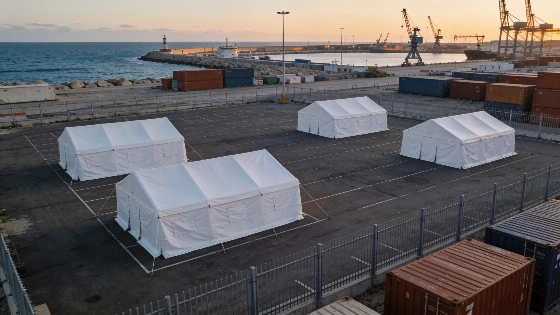
Madrid has taken direct control of Ceuta’s port to accommodate more than 1,000 migrants. The move bypasses local president Vivas and has triggered protests among residents and officials. The decision highlights the escalating migration crisis in the enclave.
Madrid has taken over control of Ceuta’s port, moving to house more than 1,000 migrants in the city. The decision, made without local approval, has drawn immediate protests from residents and from Ceuta’s president, Vivas, who has openly opposed the central government’s plan.
The move is the latest attempt to manage the steady flow of migrants arriving in Ceuta. By taking charge of the port, Madrid aims to coordinate the reception and organization of new arrivals, arguing that a unified response is needed to avoid further disorder and to meet basic humanitarian needs. Local officials, however, see this as an attack on their authority and another source of tension in a city already under strain.
The Spanish government allocated approximately 16,000 square meters of the port's expansion zone specifically for the new migrant camp.
Demócrata
Ceuta’s location on the African coast makes it a frequent entry point for migrants trying to reach Europe. The latest arrivals have pushed local resources to the limit, with over a thousand people now needing urgent shelter. Madrid stepped in after earlier talks with local officials failed to produce a solution, leaving the central government to act on its own.
Residents have responded quickly, gathering near the port to protest. Many are worried about security, stretched resources, and the lack of local input. City officials, led by Vivas, accuse Madrid of ignoring Ceuta’s needs and acting without proper planning or support. This is not the first time such disputes have surfaced; a recent standoff over the transfer of migrant minors from Ceuta showed similar divisions.
For the migrants, the government’s action means temporary shelter but little certainty about what comes next. The port is being adapted to provide basic services, but it is unclear how long this arrangement will last or what the long-term plan is for those staying there. The city’s social fabric is under pressure, with both humanitarian and political challenges growing as the crisis continues.
According to Reuters, the number of migrants remaining in Ceuta after the recent influx is estimated between 5,000 and 10,000, including about 1,200 unaccompanied minors. The Spanish government has increased the capacity of temporary centers from 500 to over 3,400 places and deployed more than 1,600 police officers to the city.
Reuters
Madrid’s takeover of the port is a clear sign that the government is willing to override local objections to manage the migration crisis. While this may bring some order in the short term, it also highlights the ongoing disconnect between national policy and local realities. Ceuta remains caught between the demands of Madrid and the pressures on the ground, with no long-term solution yet in sight.