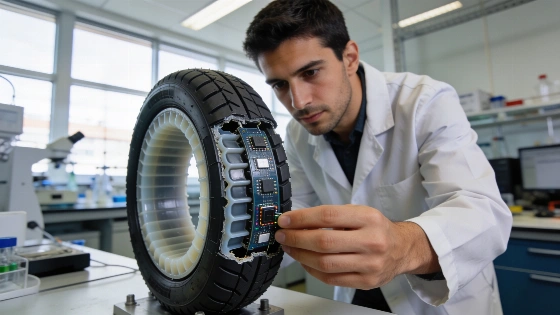
A team at Universidad Carlos III de Madrid has built a modular tyre packed with sensors. Their silicone-based prototype could help cut pollution and make cars safer.
Millions of tyres end up in landfills every year. Most are tossed out even though much of the casing is still good. At Universidad Carlos III de Madrid, a research team says they have a better idea. Their new modular tyre could change how cars handle the road—and how much waste we create.
The ECOTIRE project ditches the usual chemical bonds that hold tyres together. Instead, the team uses a mechanical system. Only the tread—the part that wears down—gets replaced. That tread is less than a fifth of the tyre’s weight. The rest stays in use much longer. Universidad Carlos III de Madrid says this could cut both material use and tyre waste in the auto industry.
In laboratory tests, the silicone tread demonstrated approximately ten times less wear than conventional rubber, while maintaining more stable performance.
Lead researcher Daniel García-Pozuelo points out a big problem: old tyres not only pile up as waste, but also shed harmful particles into the air. The team’s switch to a mechanical connection and silicone rubber has paid off. Tests show ten times less wear than standard rubber and steadier performance. These results, published in Applied Sciences, point to a tyre that lasts longer and pollutes less.
The ECOTIRE isn’t just about new materials. It’s loaded with sensors. These turn the tyre into a real-time data source. The sensors track pavement forces, contact pressure, slip angle, and grip. This data could help Advanced Driver Assistance Systems (ADAS) and self-driving cars react faster to road risks. Independent tests published in Measurement put the modular tyre on a rotating drum. Researchers controlled load, radius, slip angle, slip ratio, and pressure to see how the tyre held up under different conditions.
García-Pozuelo says the goal is clear. They want a tyre that lasts longer and talks to the car and the road. In practice, the tyre could warn systems like ABS about aquaplaning or ice before the driver even feels it. That could mean safer, earlier braking. But Universidad Carlos III de Madrid notes that data on sensor accuracy, wet or icy grip, and regulatory approval is still missing. These features are promising, but not yet proven in real-world use.
The ECOTIRE prototype has undergone extensive bench testing, with results indicating that its performance is already close to that of conventional tyres. Nevertheless, the project is still in the pre-market phase, and full-scale road trials and commercial deployment will require further development and industry collaboration.
Lab results published in Measurement show the modular tyre holds up under different loads and pressures. Its performance is close to regular tyres. The technology isn’t ready for mass production yet. García-Pozuelo thinks it’s getting close. Industry partners could help bring it to market.
The push for smarter, greener tyres comes as carmakers face pressure to shrink their environmental impact. The ECOTIRE’s modular design and real-time sensing fit with bigger trends in mobility. Spain is already moving toward self-driving vehicles, as reported earlier by this publication.
For now, ECOTIRE is still a prototype. It cuts waste, lasts longer, and packs in smart tech. The next step is tough. Lab success must turn into daily use. That will test both the technology and the willingness of carmakers and regulators to set a new standard for tyres.