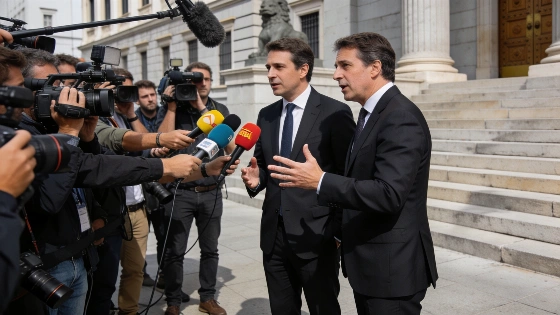
The Supreme Court's suspension of voting rights for new citizens has reignited fierce accusations from PP and Vox, who claim the government is engineering the electoral process. The dispute now centers on the integrity of Spain's voting system.
Spain's political scene is once again in turmoil after the Supreme Court suspended voting rights for people naturalized under the so-called ley de nietos. The provisional decision, issued on September 8–9, 2026, affects those who cannot individually prove their ancestors were exiled for political, ideological, religious, or sexual orientation reasons, according to El País and BBC Mundo. The ruling does not revoke citizenship, but it temporarily blocks registration in the overseas electoral roll (CERA) and participation in voting until a final decision is made.
PP and Vox quickly seized on the suspension, presenting it as evidence of a larger scheme. Leaders like Isabel Díaz Ayuso and Santiago Abascal have repeatedly accused the government of trying to tilt the electoral field. At a rally in Ifema, Madrid, Ayuso accused Sánchez of preparing a "pucherazo," setting off a wave of suspicion that has only grown since the court's move.
The Spanish government did not support the Supreme Court's decision, with the State Attorney's Office arguing that suspending voting rights affects a fundamental constitutional right.
These accusations are part of a pattern. For the past four years, the Spanish right has pushed the idea that the government—and Sánchez personally—will bend the rules to gain an electoral edge. Sometimes the claims are blunt, other times they come as hints or questions, but the message is the same: the vote is being rigged.
One recurring theme is the controversy over Indra, the tech company that publishes election results. After the 2022 Andalusian elections, PP figures like Esteban González Pons and Cuca Gamarra suggested that government influence over Indra, through the public company SEPI, could be used to manipulate outcomes. These claims continued even though Indra does not count ballots, but only publishes results. Vox went further, spreading doubts about Indra's role in elections abroad, including in Colombia.
Correos, Spain's postal service, has also come under suspicion, especially during the July 2023 general elections. With millions of Spaniards on holiday, postal voting logistics became a flashpoint. PP leader Alberto Núñez Feijóo publicly urged postal workers to deliver all ballots regardless of management instructions, hinting at government interference. Vox warned the electoral board that the results could be compromised. In practice, over 93% of the 2.6 million requested postal votes were cast—one of the highest rates since 2005.
The legal challenge that led to the suspension of voting rights for some new citizens was initiated by Vox and Iustitia Europa, who specifically sought to block registrations in the CERA electoral roll for this group. The controversy has sparked a major political debate in Spain and among Spanish communities abroad, especially as the ley de nietos is closely linked to the broader Ley de Memoria Democrática, which expanded citizenship access for descendants of exiles.
The skepticism did not fade after the elections. In June, PP raised concerns about Leire Díez, a former Correos executive and PSOE member, suggesting her involvement in postal voting management was questionable. Correos clarified that Díez never oversaw the voting process, but PP and Vox kept questioning the system's integrity, tying their doubts to broader claims of government manipulation.
The release of audios from the case Koldo added more fuel, with PSOE figures discussing irregularities in party primaries. Former Prime Minister José María Aznar compared such actions to a criminal moving from robbing a jewelry store to a bank, arguing that if internal party votes could be rigged, so could national elections. Feijóo echoed these concerns, calling for strict oversight by the electoral board, while Vox's Abascal said trust in the system was impossible.
The latest dispute over the ley de nietos has deepened the divide. PP and Vox argue that granting nationality to descendants of exiles is less about historical justice and more about creating new voters for the government. The Supreme Court's decision to halt these new citizens' voting rights has strengthened their claims, even as the government insists the measure is legal and fair.
Spain's electoral system is among the most regulated in Europe, with multiple safeguards against fraud. The Central Electoral Board, independent judiciary, and transparent ballot counting are designed to prevent manipulation. Still, the ongoing campaign by PP and Vox to cast doubt on these institutions has consequences. It erodes public trust, polarizes debate, and shifts attention from policy to suspicion. The Supreme Court's intervention may have given the right a short-term rhetorical win, but it leaves Spain's political climate more divided and mistrustful.