A Tarragona judge has halted a pension case to ask Europe if Spain’s rules unfairly penalize women. The dispute centers on a widow forced to choose between her retirement and survivor’s pension due to a law affecting mostly women divorced before 2008.
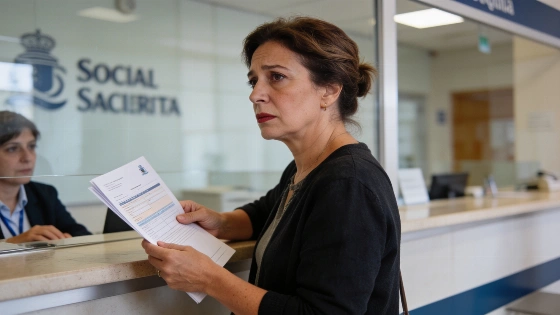
The case started with a letter from Spain’s Social Security office. A 70-year-old widow in El Vendrell learned she could not keep both her retirement and widow’s pensions. She refused to accept it. Instead, she took her fight to court. Now, her challenge has landed in Europe’s top court. Spain’s pension rules are under the microscope for possible gender bias.
The problem comes from a rarely discussed rule: the thirteenth transitional provision of Spain’s General Social Security Law. This clause targets people who separated or divorced before 2008. It blocks them from getting a widow’s pension and any other public pension at the same time. The woman at the center of this case married in 1977, separated in 2002, and started drawing a contributory retirement pension in 2019. When her ex-husband died in 2024, she faced a harsh choice. She could keep her €872.37 monthly retirement, or switch to a widow’s pension of €887.79. The law forced her to pick one. She could not have both.
According to Diari de Tarragona, this incompatibility rule is not a general norm for all widow’s pensions, but applies specifically to cases involving divorce or separation before 2008.
She tried to claim both. The Social Security office stopped her retirement payments as soon as she chose the widow’s pension. They pointed to the incompatibility rule. She sued. She demanded both benefits and back payments for what she lost. The Tarragona judge did not rush a verdict. Instead, the judge paused the case and sent two direct questions to the Court of Justice of the European Union (TJUE). The key question: does this rule amount to indirect discrimination against women?
The numbers are clear. Out of 6,789 widow’s pensions granted under this rule, 6,645 went to women. Only 144 went to men. Nearly 98% of those affected are women. This is not just about one person’s pension. The judge wants to know if a rule that looks neutral on paper is actually punishing women for divorces that happened before 2008.
Lawyer Jerónimo Martín, who represents the widow, says the judge’s move is important. The court is not just following the law by rote. It is asking if the rule’s impact on women is fair under European law. In Spain, most people can combine retirement and widow’s pensions. Only those separated before 2008 face this block. For thousands of women, this technicality has real consequences.
As noted in La Opinión de Murcia, in most cases in Spain, a widow’s pension is compatible with both employment income and an old-age pension, highlighting the exceptional nature of this transitional provision for pre-2008 separations.
This is not the only case. Another dispute with similar facts is already before the TJUE. In that case, the order was reversed: the claimant got a widow’s pension first, then applied for retirement. Here, the sequence is flipped. The core issue is the same. Does the law unfairly target women?
Social Security data shows almost everyone affected is a woman. That raises the question of indirect discrimination. No one knows when Europe will rule. The decision could change how Spain treats pension rights for divorced and separated women.
Spain’s pension system has faced other problems lately. Inflation has pushed up payments. Delays have frustrated claimants, as reported earlier by Russpain. But this case is different. It is about gender and legal fairness, not just numbers.
One thing is obvious. When a law that claims to be neutral ends up hurting almost only women, fairness is in doubt. A Spanish judge has now asked Europe to step in. That is rare. The answer could set a new rule for thousands of women across Spain. Old laws and equal rights are now on a collision course.