Stellantis has patented a system that can eject an electric car’s battery if it overheats or catches fire. The move comes as Spain faces real concerns over EV safety in garages after fatal incidents and new restrictions on charging.
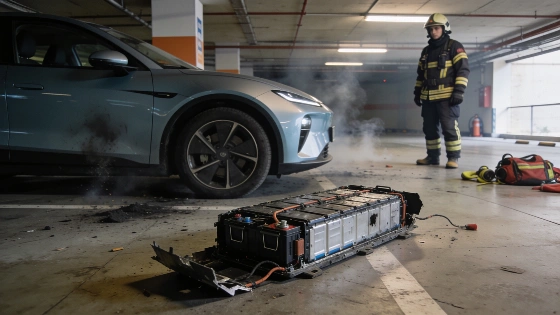
Battery fires in electric cars move fast. Stellantis now has a patent for a system that throws out the high-voltage battery as soon as it senses thermal runaway. The idea is simple: get the most dangerous part away from people and property, fast.
The US Patent Office published the filing on September 17, 2026. The document calls it a “High-Voltage Battery Quick Release System For Vehicle.” If the system picks up signs of severe overheating, major damage, or a chain reaction inside the battery, it can drop the battery pack straight onto the road. The car then uses a backup 12-volt battery to roll itself a short distance away. This gives people and first responders a few crucial seconds to get clear.
The patent names FCA US, part of Stellantis, as the applicant and describes both pyrotechnic and mechanical release mechanisms for the battery.
Stellantis describes two ways to release the battery. One uses pyrotechnic bolts—tiny explosive charges that cut the battery loose in an instant. The other uses a mechanical sliding system. The trigger could be a lever, a button, or a touchscreen. Drivers, passengers, or firefighters could all activate it. But the patent leaves out some big details. It does not say how far the car can move after losing its main battery. It also does not explain what happens if the battery drops in a tight garage or on a busy street.
Spain is watching this idea closely. Deadly fires in underground car parks in Madrid and Alcorcón in 2024 and 2025 killed two firefighters. Some garages have now banned EV charging, as reported by El Diario de Madrid. There is still no UNE standard in Spain for lithium battery fires in vehicles. Building managers and insurers are stuck in a legal grey area. The problem is not just Spanish. In China, new rules since July 2026 force batteries to resist fire for at least two hours after thermal runaway. Nio and other brands have chosen battery swap stations instead of quick-release systems.
There are real-world problems. A battery dropped on a garage floor or highway could hit other cars or start new fires. The patent does not say who pays for the damage or how insurance would handle it. These questions echo the headaches in Spain’s city parking. As reported earlier, car lifts are now common because old-style ramps are disappearing.
Since July 2026, China has enforced the GB 38031-2025 standard, requiring that after a thermal runaway event, EV batteries must not ignite or explode for at least two hours, and smoke must not enter the passenger cabin. This is a significant tightening compared to previous regulations, which only required a five-minute warning before fire.
A patent is not a product. Stellantis may never build this system. The document does not mention any European launch or timeline. The company is also testing safer battery tech, like solid-state batteries with Factorial for the Dodge Charger Daytona. These are seen as more stable than today’s lithium-ion packs. That model is not made in Spain. For now, the quick-release patent is just a legal option, not a production plan.
Stellantis is showing how far carmakers might go to tackle battery fire risks. Spain’s EV market is growing, but public trust is shaky after high-profile fires. Until clear rules and real fixes arrive, the industry walks a tightrope between new ideas and safety. The legal and practical details are still up in the air. For now, the patent is a bold idea. But it is still untested.