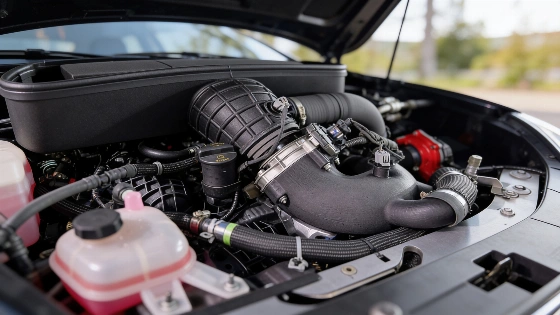
Stellantis is testing a new electric compressor system for its Hurricane 3.0 engine, targeting the long-standing issue of turbo lag. The eBoost Air promises faster, more linear power delivery without sacrificing high-end performance.
Stellantis is taking direct aim at one of the most persistent challenges in high-performance engines: turbo lag. The company’s SRT division has introduced eBoost Air, an electric compressor system designed to deliver immediate throttle response in the Hurricane 3.0 inline-six biturbo engine. While still in the prototype stage, the technology signals a new approach to balancing power and drivability in modern combustion engines.
Traditional turbochargers rely on exhaust gases to spin a turbine, which then compresses air into the engine. This setup works well at high revs, but large turbos often struggle at low speeds, creating a noticeable delay between pressing the accelerator and feeling the surge of power—a phenomenon known as turbo lag. Over the years, manufacturers have tried various solutions, but SRT’s latest move is to address the problem from the intake side rather than the exhaust.
The eBoost Air system places an electric compressor ahead of the Hurricane’s two conventional turbochargers. Unlike electric turbos that directly spin the main turbines, this device pre-compresses air and pushes it toward the turbos, helping them reach optimal speed much faster. When the driver demands instant acceleration and the turbos are not yet fully spooled, electronically controlled valves reroute intake air through the e-compressor. This delivers boost pressure almost instantly, allowing the main turbos to engage sooner. Once exhaust flow is sufficient, the system disengages and air returns to its normal path.
This approach differs from other manufacturers who have opted to electrify the turbo itself. Stellantis aims to give the Hurricane engine a response reminiscent of a supercharged V8—immediate and forceful—while retaining the benefits of large turbos for high-end power. According to SRT, eBoost Air does not increase the engine’s peak horsepower, but it enables the Hurricane to reach its maximum performance levels more quickly and with greater consistency.
Importantly, the system requires a 48-volt electrical supply to power the compressor. Unlike more complex energy recovery systems, eBoost Air simply draws electricity during the brief window when the turbos need assistance, without recapturing energy when idle. Integrating the technology into the Jeep Grand Cherokee prototype was a challenge, as engineers had to find space for the new compressor and add a third air intake route. Despite these hurdles, SRT managed to develop the prototype in just seven weeks—a rapid pace for a technology still in demonstration phase.
While some purists may see this as a departure from traditional gasoline engines, Stellantis North America’s Tim Kuniskis argues that enthusiasts embrace technology when it delivers real performance benefits without drawbacks. The company’s goal is to combine the immediacy of classic supercharged engines with the efficiency and power potential of modern turbocharging.
Looking ahead, eBoost Air could pave the way for even larger turbochargers in future engines, as the electric compressor helps offset the increased lag typically associated with bigger units. This would give engineers more freedom to pursue higher power outputs without sacrificing low-end response. The move reflects a broader industry trend toward electrified solutions for traditional engine challenges—a direction also seen in recent innovations like the electric trailer system for diesel trucks, as highlighted in coverage of hybrid freight technology.
For now, eBoost Air remains a prototype, but its rapid development and promising results suggest Stellantis is serious about redefining what drivers can expect from turbocharged engines. As the automotive sector continues to evolve, such hybrid solutions may become increasingly common, bridging the gap between classic performance and modern efficiency.