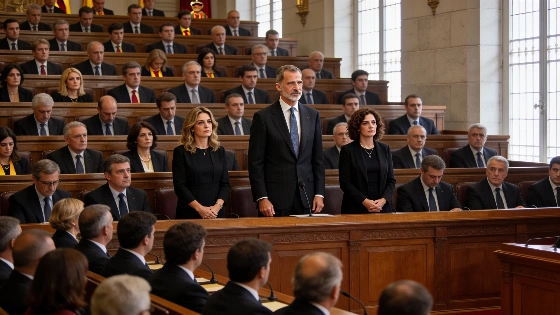
The Supreme Court has temporarily blocked voting rights for people naturalized under the Law of Democratic Memory, setting off a direct conflict with the government. The judicial year began under the weight of this rare legal standoff.
The Supreme Court’s decision to suspend voting rights for people who gained Spanish citizenship through the Law of Democratic Memory has triggered a direct conflict with the government, overshadowing the official start of the judicial year. The ruling, which affects those naturalized under the so-called "ley de nietos," has immediate consequences for thousands and highlights a deep split between Spain’s institutions.
King Felipe VI opened the annual ceremony at the Supreme Court, a tradition that marks the start of the judicial calendar each September. This year, the event was far from routine. The monarch was joined by Supreme Court president Isabel Perelló, the head of the judicial council, and the state prosecutor, Teresa Peramato. Top government and legal officials—including Félix Bolaños, Alberto Núñez Feijóo, Francina Armengol, Pedro Rollán, and Cándido Conde-Pumpido—filled the chamber, underlining the seriousness of the dispute.
"The Supreme Court's suspension is a provisional measure: citizenship is not revoked, but the right to vote and registration in the electoral census are temporarily blocked for some naturalized under the Law of Democratic Memory."
Based on reporting from ARA and La Voz de Galicia
The current standoff centers on the Supreme Court’s intervention in how the Law of Democratic Memory is applied. By suspending voting rights for those naturalized under this law, the judiciary has challenged the executive’s authority to define citizenship rights. The Spanish Ministry of Foreign Affairs has stated that citizenship under this law does not automatically include all rights, such as voting—a legal distinction now at the heart of the dispute. The government sees the court’s move as overstepping, while the judiciary argues it is upholding legal standards.
This legal fight is not happening in isolation. Spain has faced similar institutional clashes in recent years, such as the Constitutional Court’s suspension of regional memory laws in Extremadura. The ongoing tension between legislative intent and judicial interpretation remains unresolved. The government and the State Prosecutor's Office opposed the suspension, arguing it would affect the constitutional right to vote, according to Democrata.
For those affected, the impact is immediate. New citizens who thought their rights were secure now face uncertainty about their ability to vote. The government’s credibility is at stake, as is the judiciary’s claim to impartiality. King Felipe VI’s presence at the ceremony, while symbolic, could not hide the underlying power struggle shaping Spain’s legal and political climate.
"The Supreme Court's measure may impact thousands of newly naturalized citizens abroad, particularly in Latin America and Cuba, though no single official source confirms the exact number. The court requires consular proof that ancestors were exiled for political, ideological, religious reasons, or due to sexual orientation or gender identity."
La Voz de Galicia and Cibercuba
Spain’s approach to historical memory and citizenship has become a flashpoint for debates about national identity, legal authority, and the limits of institutional power. The Law of Democratic Memory was meant to address past injustices, but its rollout has sparked new conflicts at the heart of the state. The Supreme Court’s intervention shows a judiciary willing to assert itself, even if it means open confrontation with the executive. This episode exposes not only the fragile consensus on citizenship, but also the readiness of Spain’s institutions to test the limits of their power. The outcome will shape both the rights of new citizens and the balance between Spain’s branches of government.