Spain’s Supreme Court has suspended voting rights for thousands who gained citizenship under the ‘ley de nietos’. The decision, citing fears of electoral fraud, has sparked rare internal conflict among top judges.
Spain’s Supreme Court has suspended the voting rights of thousands of people who recently became citizens under the so-called ‘ley de nietos’. The court says the move is a response to what it calls a "real and serious" risk of electoral fraud. The decision has triggered a heated debate within the judiciary and left the rights of around half a million new Spaniards in question.
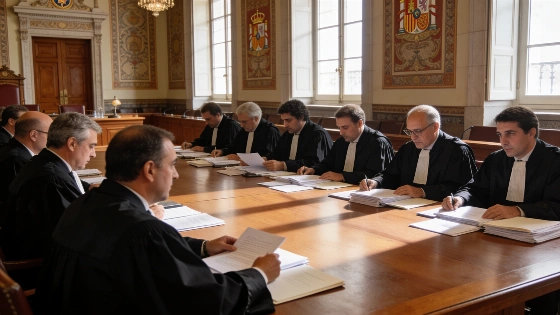
The ruling came from the Supreme Court’s Third Chamber after four hours of closed-door talks among six judges. The case was brought by Vox and Iustitia Europa, who argued that the government’s use of the 2022 Democratic Memory Law had swelled the electoral roll of Spaniards living abroad (CERA) by granting nationality too broadly. The court’s majority agreed, even though there was no concrete evidence of fraud, and ordered a temporary suspension of voting rights for those nationalized under the Justice Ministry’s instruction. According to BBC Mundo and El País, the measure affects those who cannot provide documents proving they are descendants of political, ideological, or religious exiles. Those who can show such lineage keep their rights.
By May 31, more than 2.4 million people had applied or registered at Spanish consulates under the grandchild law, showing the scale of interest and the potential impact.
The dispute centers on a Justice Ministry directive that treated all Spaniards who left the country between July 1936 and December 1955 as exiles, making their descendants eligible for Spanish nationality. Neither the far-right parties nor the Supreme Court challenged the law itself, but both targeted the ministry’s broad interpretation, which they say allowed irregular nationalizations and could affect future elections. As reported by El País, the legal challenge did not seek to overturn the law, but to limit the Ministry’s wide application of exile status to all emigrants from that period.
The makeup of the judicial panel added to the controversy. Three of the six judges—Luis Díez-Picazo, Rafael Requero, and Antonio Fonseca-Herrero—are known for conservative views. Requero has opposed same-sex marriage, and Díez-Picazo was involved in a high-profile reversal on mortgage tax law. The other three judges, including progressive Alicia Millán, joined the Supreme Court after the 2024 renewal of the General Council of the Judiciary. Millán was the only dissenting voice, arguing that suspending voting rights was excessive and that the Supreme Court did not have the authority to review the Justice Ministry’s instruction, since it had not been formally challenged.
The decision was not unanimous. Five judges supported the suspension, while Millán prepared a dissenting opinion, saying the risk of fraud was unproven and the court was overreaching. The ruling was made public before the full legal reasoning was released, leaving even some Supreme Court members surprised and questioning the legal basis for such an unusual step.
The Supreme Court’s decision is a provisional measure and does not cancel the naturalization process itself; the final ruling on the main issue is still pending. Spanish and international media note that the temporary suspension affects both those already registered in CERA and those whose registration is still being processed, pending verification at consulates.
The effects go beyond the immediate suspension. The Supreme Court’s move directly challenges the authority of the Central Electoral Board (JEC), whose leadership includes several Supreme Court judges. The JEC had previously said it was not responsible for overseeing the electoral impact of the Democratic Memory Law, a position now in question after the court’s intervention. If the Supreme Court eventually overturns the JEC’s decision, it would be a rare case of the court reversing its own members’ collective judgment.
Legal experts warn that the stakes are high. If the court’s final ruling, expected in December, invalidates the Justice Ministry’s instruction, it could threaten not only voting rights but also the nationality status of more than half a million people who have already become citizens under the ‘ley de nietos’. Such a move would undermine the legal certainty of administrative acts usually considered final in Spanish law. According to El País and other major Spanish outlets, representatives of Spaniards abroad have condemned the decision, calling it a blow to new citizens’ rights and fueling wider public controversy.
This episode has exposed deep divisions within Spain’s highest court and brought the intersection of nationality, electoral law, and political suspicion into sharp focus. The Supreme Court’s willingness to act on unproven fraud claims, echoing arguments from the right and far right, marks a shift in judicial activism that could erode trust in both the legal system and the democratic process. The court’s open conflict with its own members on the JEC adds to the sense of institutional crisis. As the country waits for a final ruling, the outcome could have lasting consequences for national identity and democratic participation in Spain.