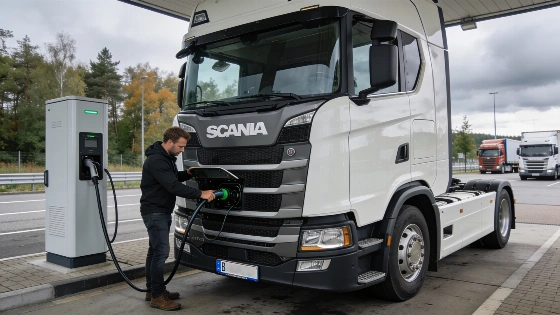
Scania Engineer Drives 73,500 km in Electric Truck Across 21 Countries. Anders Gaasedal from Scania spent two and a half years testing an electric truck on real routes throughout Europe. He collected data on consumption, charging, and savings to evaluate whether the market is ready for the switch to electric trucks.
Andrés Gaasedal, a 45-year-old engineer at Scania, set out to test how well an electric truck could replace traditional diesel trucks on long-haul routes. Over two and a half years, he covered 73,500 kilometers across 21 European countries—including Spain, Germany, France, Italy, and the Baltic states—using a Scania R45 electric tractor unit with a 624 kWh battery and up to 500 kW of power.
The experiment began with aerodynamic tests in Germany but quickly escalated into a large-scale trial of electric power on real roads. Gaasedal didn't just log kilometers—he collected precise data on energy consumption, charging times, operational costs, and the day-to-day specifics of driving an electric truck.
Practice over theory
On one trip, the engineer crossed seven countries over 4,340 kilometers with a total weight of 27 tons. The average speed was 76 km/h, and energy consumption came to 0.98 kWh per kilometer. Across all journeys, average consumption stayed between 0.94–0.98 kWh/km, even in cold weather and on high-speed roads.
Gaasedal notes that a heavy truck can recover more energy during braking than a passenger EV, which benefits overall efficiency. According to his calculations, on a route to Spain, the savings compared to a diesel truck amounted to around €1,000 just on energy and tolls, and between Germany and Sweden—to 28 euro cents per kilometer.
Charging and infrastructure
One of the main concerns for carriers remains the long charging stops. However, Haasedal's experience showed that during the legally required 45-minute break, it is possible to recharge more than half of the battery, which is enough for the next 4.5 hours of driving. Thus, the charging schedule fits seamlessly into the truck driver's work routine.
During the experiment, the engineer noted a noticeable improvement in infrastructure: whereas at first it was necessary to maneuver a 17-meter truck to passenger car charging stations, now more truck-suitable stations have appeared in Central and Northern Europe. Drivers can choose locations based on price, convenience, and route, though growth in network quality is still needed—faster, more accessible, and integrated solutions are required.
Winter and range
Loss of range in cold weather is another frequent argument against electric trucks. But according to Haasedal, this effect is less pronounced in trucks than in passenger vehicles: thanks to the long driving periods, the batteries cool down less, and the decrease in range does not become critical.
The Scania BEV-Into the Wild experiment demonstrated that electric trucks are already capable of operating on international routes without loss of efficiency and with actual savings. For the industry's large-scale transition, further development of charging infrastructure and logistics adaptation will be needed, but technological barriers are becoming less and less significant.