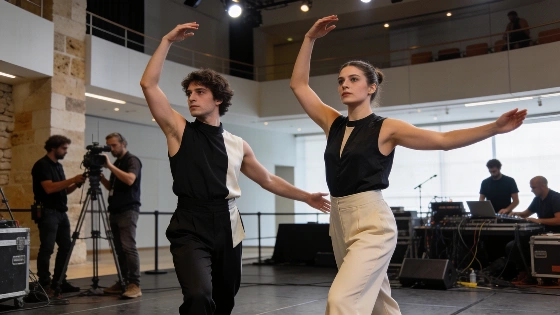
The 35th Temporada Alta festival in Girona and Salt will feature 91 shows, including 16 international productions and 22 world premieres. Major names like Needcompany, Peeping Tom, and Sidi Larbi Cherkaoui are confirmed.
The Temporada Alta festival in Girona and Salt is set to mark its 35th edition with a strikingly international and diverse programme. Running from 3 October to 8 December, the event will present 91 performances, including 22 world premieres and 16 international productions. The festival, a key date in Spain’s cultural calendar, will bring together some of the most acclaimed names in contemporary theatre and dance, such as Needcompany, Peeping Tom, Romeo Castellucci, Sidi Larbi Cherkaoui, Christiane Jatahy, Claudio Tolcachir, and Guy Cassiers.
Organisers have confirmed that tickets—45,436 in total—will go on sale from 3 September. The festival operates with a budget of €3,153,000, of which €800,000 is provided by the Generalitat de Cataluña. This financial backing underlines the event’s significance for both the region and the wider Spanish performing arts scene.
The opening performance will be Has Been, a collaboration between choreographer Sidi Larbi Cherkaoui and circus artist Martin Zimmermann. Among the most anticipated world premieres are Everything must change by Needcompany and Le salón ‘revisited’ by Peeping Tom, a new take on one of their signature works. Romeo Castellucci will present a reinterpretation of the Faust myth, while Claudio Tolcachir’s The forest will feature Pina Bausch company dancer Cristiana Morganti. Guy Cassiers, together with actress Valérie Dréville, will stage Théséz, sa vie Nouvelle, exploring memory and the reconstruction of Europe through the lens of French essayist Camille de Toledo.
The festival also highlights a strong presence of Catalan and Spanish creators, including La Veronal, Mal Pelo, Baró d’Evel, Lluïsa Cunillé, Jordi Casanovas, Victoria Szpunberg, Carlota Gurt, and Ramon Madaula. The music programme will feature acts such as Pink Martini, Martirio, and Eliades Ochoa, a veteran of the Buenavista Social Club.
Other notable international entries include Hermanos Ibarra Roa with La muerte del padre and Oligor y Microscopia with Museo de los relámpagos, both part of the Ibero-American Connection section. Brazilian director Christiane Jatahy will return with Júlia - 15 anys més tard, revisiting her acclaimed adaptation of Strindberg’s Miss Julie, now co-produced with Teatre Lliure and starring Júlia Genís and Moha Amazian.
Baró d’Evel’s Marc Pesarck Blaï Mateu, alongside his father Tortell Poltrona, will present LAB: A la recerca de ‘Qui soc?’, offering a glimpse into the creative process behind the Franco-Catalan company’s next production. Mal Pelo will debut Bach en familia, continuing their exploration of the music of Johann Sebastian Bach.
In total, 66 Catalan productions across all genres and formats will be staged. The Spanish theatre scene will also be represented by Pablo Messiez with La forma humana and Personas, lugares y cosas; Pablo Remón and Javier Cámara with Verborrea; Rocío Molina with Calentamiento; and Lolita Flores reviving her role in Poncia.
The festival’s Big Bang contemporary creation week will run from 19 to 22 November, focusing on works with international touring potential and fostering connections between artists, companies, and programmers. The programme includes the screening of Qui som, a film by Salvador Sunyer i Vidal about Baró d’evel, and will feature 10 performances in total.
Temporada Alta will take place across 22 venues in nine Catalan municipalities, with Maçanet de la Selva joining as a new satellite location. Festival director Narcís Puig highlighted the event’s growth since its inception, with 2,253 performances and 1,302,620 spectators to date. He emphasised that the festival remains committed to supporting artistic creation, opening new perspectives, and building connections with audiences and the region.
Temporada Alta has become a reference point for contemporary performing arts in Spain, regularly attracting international attention. Its blend of established and emerging talent, along with a strong focus on premieres and cross-border collaborations, positions it as a leading platform for innovation in theatre and dance. The festival’s continued expansion into new venues and its support for local creators reflect broader trends in Spain’s cultural policy, which increasingly values both international exchange and regional identity.