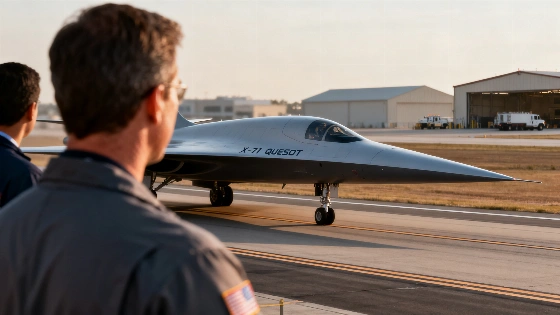
NASA Prepares Supersonic X-59: Transatlantic Flight in 3 Hours Becomes More Realistic. NASA and Lockheed Martin are finalizing preparations for testing the X-59 QueSST—an aircraft capable of crossing the Atlantic in three hours without a loud sonic boom. The project could reshape regulations for supersonic passenger flights and open up new routes.
NASA has announced the date for the first test flight of the X-59 QueSST—an experimental aircraft designed to prove that flying from London to New York in three hours is possible not just on paper. In June 2026, actual trials will begin in the US, with the primary focus not only on speed but on minimizing noise when breaking the sound barrier.
Unlike previous supersonic airliners, the X-59 QueSST is being developed together with Lockheed Martin with an emphasis on reducing sonic boom. Thanks to its unique aerodynamics—30 meters in length, 9-meter wingspan, and an elongated, slender nose—the aircraft is expected to replace the familiar loud boom with a sound comparable to a car door closing: only 75 dB. This paves the way for flights not just over oceans, but also over densely populated areas.
Technologies and Specifications
The aircraft is designed for a cruising altitude of 16,800 meters and speeds up to Mach 1.4 (1,488 km/h). The General Electric F414-GE-100 engine is mounted on top to direct noise upward, away from the ground. Instead of a conventional windshield, the pilot navigates using an external vision system: a 4K camera and a cockpit monitor provide real-time visuals.
The X-59 project is part of the Low-Boom Flight Demonstration mission. NASA plans not only to test the aircraft itself but also to collect data on noise perception from residents in areas where flights will take place. These data will serve as an argument for revising international aviation regulations: currently, restrictions for supersonic flights are based on speed rather than actual noise levels.
Capabilities and Limitations
If the X-59 meets its declared specifications, the flight time between London and New York could be cut in half—to three hours. However, launching commercial flights depends not only on technology: regulators must be convinced that the new noise standard is safe for cities. In 2027, NASA will begin a series of flights over various US cities to gauge public reaction and collect objective data through surveys and sensors.
Why it matters
NASA's main goal is not just to build a fast aircraft, but to change the approach to regulating supersonic transportation. Unlike Concorde, which was forced to fly only over the ocean due to noise, the X-59 could be the first step towards returning supersonic passenger flights over land. If regulators adopt new standards, it will open the market for new routes and technologies.
Interestingly, large-scale aviation projects are already being implemented around the world. For example, China is building an airport on an artificial island covering 20 km², designed for tens of millions of passengers and able to withstand extreme weather conditions. You can find out more about such infrastructure solutions in the article .
What to keep in mind
For now, the X-59 QueSST is an experimental project. Its first flight in 2026 will only mark the beginning of a series of tests, and commercial flights will be possible only after new regulations are approved. Yet the fact that NASA and Lockheed Martin are close to real-world trials is already changing perceptions of aviation's future: speed and comfort may cease to be mutually exclusive.