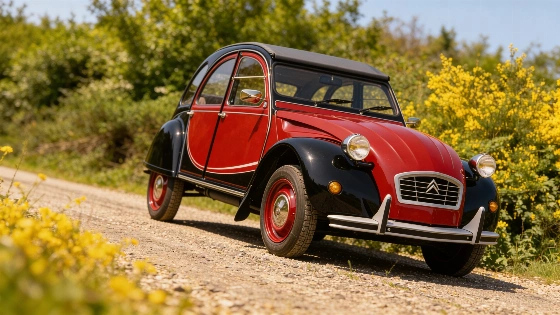
Citroën prepares the return of the legendary 2CV: electric version already on the horizon. Citroën has officially hinted at the return of the 2CV—one of the most recognizable cars of the 20th century. The new version is rumored to be electric and could be unveiled as early as this year. We revisit the model's history and analyze what the future 2CV Charleston may look like.
Citroën has found itself in the spotlight after the brand’s CEO, Xavier Chardon, confirmed that the return of the 2CV is more than just a rumor. According to French media, the company is already working on a new generation of the iconic car, which once became a symbol of affordability and simplicity for millions of Europeans.
The original Citroën 2CV appeared after World War II, although the Très Petite Voiture (TPV) project began as early as 1938. The war interrupted development, but in peacetime the model quickly gained popularity not only among rural residents, for whom it was originally created, but also in cities. Over 41 years of production, more than five million units rolled off the assembly line, and the last car left the Mangualde plant in Portugal in June 1990.
Today, as the European auto industry actively returns to classic models in a new interpretation, Citroën has not stood aside. As russpain.com notes, the interest in reviving legendary cars is confirmed by the actions of other brands: for example, Renault has already presented modern versions of the 5 and 4, as well as the new Twingo. In this context, the return of the 2CV appears to be a logical step for Citroën.
Electric 2CV: a new chapter
The company has not yet disclosed technical details, but insiders insist: the new Citroën 2CV will be fully electric. This choice is due not only to the current trend for electric vehicles but also to the necessity of meeting the European Union's strict environmental standards. The first prototype is expected to be unveiled as early as October, possibly at the Paris Motor Show — the same venue where the original 2CV debuted in 1948.
The question of production location remains open, but Spain is being considered as one of the main candidates. Stellantis, which owns Citroën, recently announced an expansion of affordable model production at its factories in Madrid and Zaragoza, which could be an advantage for Spanish enterprises.
Charleston: the return of a legend
Over its long history, the 2CV was produced in dozens of versions, but the 2CV Charleston holds a special place. This modification appeared in 1980 and immediately stood out with its two-tone body paint, original interior trim, and round headlights. Initially, the Charleston was offered in the Rojo Delage and black color combination, and later variants featured yellow and gray shades.
Charleston was intended as a limited series, but demand was so high that it became a permanent part of the Citroën lineup. Production continued until 1988, and cars assembled in Portugal are easily identified by the logo of the Spanish glass manufacturer Covina on the windows.
If Citroën does decide to release a new version of the 2CV, it is logical to expect a modern interpretation of the Charleston as well — featuring the recognizable two-tone paint and enhanced equipment. Such a move could attract not only classic car enthusiasts, but also a new audience seeking a stylish and eco-friendly city car.
Interest in reviving iconic models is also confirmed by actions from competitors. For example, Renault recently unveiled the Niagara pickup for Latin America, which was covered in detail in the piece about the strategy of French automakers in global markets. This underlines that returning to roots and adapting classics to modern standards is a steady trend in the industry.
While Citroën remains silent on the details, one thing is clear: the return of the 2CV could become one of the most notable events in the European automotive market in the coming years. All that remains is to follow the project's development and await the official premiere.