Tesla Model Y with FSD: What True Autonomy Looks Like on Europe’s Roads. In the Netherlands, the Tesla Model Y equipped with the FSD package has, for the first time, been allowed to drive across the country without driver intervention. How does the system work, why does it not require LiDAR, and what happens if the driver is distracted? Here’s an analysis based on real-world driving experience.
In the Netherlands, the Tesla Model Y equipped with the Full Self-Driving (FSD) package is officially authorized for use on all roads in the country. This marks the first case in the European Union where an electric vehicle can independently transport a passenger to any address—from the center of Amsterdam to anywhere in the country—without the driver's involvement in controlling the car. The driver is only required to be ready to intervene, but does not need to keep their hands on the wheel: the system works in 'supervised' mode, meaning under human supervision.
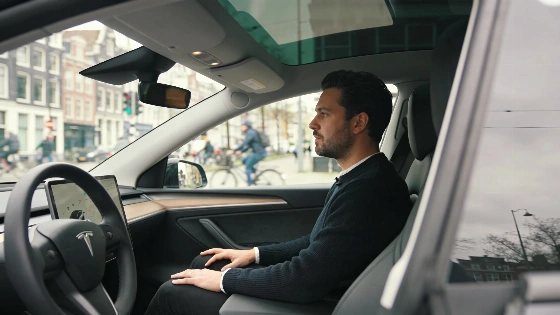
The FSD technology is based solely on software and cameras: six external lenses capture everything happening around the vehicle, while two internal cameras monitor the driver's attention. Unlike its competitors, Tesla does not use LiDAR—only visual data, GPS, and digital maps. Artificial intelligence analyzes the traffic situation, taking into account the experience of millions of kilometers already driven by other cars of the brand.
Before the trip begins, the driver must complete a short briefing and confirm that they understand the FSD usage rules. After that, it is enough to select the destination, and the car takes over control. In practice, the Tesla Model Y confidently starts from the parking lot, accelerates to the permitted speed, changes lanes autonomously, responds to cyclists and pedestrians, observes right-of-way, and performs maneuvers correctly even in complex urban conditions.
During four hours of testing on the roads of Amsterdam and the surrounding areas, the system proved to be reliable: on highways, the algorithms perform particularly well, and in the city, they respond quickly to unexpected situations. For example, when a cyclist suddenly entered the roadway, the car independently avoided a collision. However, parking still has to be done manually — this is a requirement from the manufacturer.
The system strictly monitors the driver's attention: if the hands are taken too far from the steering wheel or the person is distracted, a warning appears on the screen. Attempts to use a phone or completely ignore the situation lead to the autopilot being deactivated. The cameras even detect attempts to hide hands or get distracted — it's impossible to trick FSD.
No serious malfunctions occurred during the test, but there were some nuances: once, the car missed the correct turn and made an extra loop, and in another case it hesitated at a green light and required a gentle press on the pedal. In complex interchanges, the system sometimes loses confidence, and human intervention is required. Nevertheless, according to russpain.com, the trip was safe, and responsibility for what happens still remains with the driver.
Interestingly, outside the Netherlands, FSD is automatically disabled — in other European countries the system is still undergoing certification. The option costs €7,500 or €99 per month by subscription. By comparison, in Morocco, where the car fleet and infrastructure are quite different, driving remains much more traditional — for more on local realities, see the article about Moroccan road life through the eyes of a European driver.
The introduction of FSD in Europe is an important step toward widespread autonomy. While the system still requires supervision, it is already changing perceptions of what the future of personal transportation might look like. In the coming years, we can expect its geographic expansion and a gradual increase in trust toward such technologies.