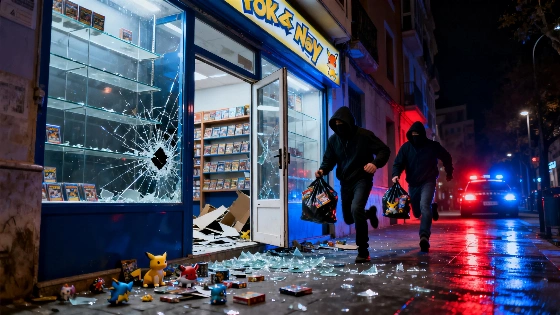
Two masked individuals broke into the Tsuki Center shop in Alcalá de Henares, Madrid, at 1:34 a.m. on May 6, stealing Pokémon cards worth between €20,000 and €30,000. The alarm went off as the thieves forced their way through the emergency door. Police arrived just four minutes later, but the perpetrators had already fled with the targeted cards.
The robbers focused on two display cases containing graded Pokémon cards, some worth more than €1,000 each. Authenticated and sealed by specialist companies, collectors prize these cards, whose prices depend on rarity and condition. The thieves also took a small amount of cash from the register but left behind the shop’s most famous item: the Pikachu Van Gogh card, created for a special collaboration with the Dutch museum.
Grading helps establish a card’s authenticity and condition, while the resulting records and serial identifiers can make high-value items easier to trace. But they do not physically prevent stolen cards from changing hands. In a separate theft in Southern California, Professional Sports Authenticator (PSA), a Collectors company, disabled certificates and serial numbers linked to stolen cards and alerted online marketplaces and auction platforms so the items could be flagged if listed. PSA also said it had contacted affected owners and was handling compensation based on fair-market value.
The shop’s owners said the break-in was carried out with precision. The intruders used a blowtorch to burn the emergency door handle and a drill to remove the lock cylinder, gaining quick access to the premises. The entire operation lasted only seconds. The owners, who had opened the shop just two weeks earlier, were left shaken and worried about security.
In February 2026, ABC News reported that three people broke into a collectibles shop in Anaheim, California, by cutting through a wall from an adjacent premises. Surveillance footage showed them taking hundreds of trading cards, including Pokémon cards, and leaving in less than ten minutes. The reported loss was tens of thousands of dollars. The incident illustrates the vulnerability of specialist retailers holding compact, high-value merchandise.
A much larger theft was reported in Santa Ana, California, on October 13, 2026, when cards valued at approximately US$963,000 were stolen from a FedEx truck parked near PSA. The Santa Ana Police Department said about two pallets were taken and a third was disturbed. The shipment included sports and Pokémon cards sent by collectors for authentication and grading; police described it as containing “various trading cards, including, but not limited to, sports cards and Pokemon cards.” Because the pallets held mixed collectibles and the third pallet was disturbed, the estimate was not a final valuation of Pokémon cards alone. The case also affected individual collectors whose items were in transit, along with the shipping and grading process.
The scale and contents of the Santa Ana shipment differ from the Alcalá de Henares loss: the California estimate covered mixed sports and Pokémon cards, while the Spanish shop’s reported losses involved selected Pokémon cards from two display cases. NewsNation reported that “approximately two pallets were stolen, and a third pallet was disturbed.” At the time of the cited reporting, Santa Ana police spokesperson Natalie García said there had been no arrests or recovery of the property. The thefts show how grading identifiers can help flag stolen collectibles without eliminating the risk of theft or resale through private channels.
Criminals have taken notice of rising card values. Stolen cards can be difficult to resell openly when their identifiers have been flagged, but that does not rule out attempts to sell them through informal markets. Spanish police are investigating all possibilities, including the theory that the Alcalá de Henares theft was commissioned. The shop’s owners and their online community are monitoring resale platforms for signs of the stolen items.
Tsuki Center’s owners had insisted on insuring their business under a jewelry-related coverage category, recognizing the high value of their inventory. That classification allowed the stolen cards to fall within the policy’s protection and may help mitigate the loss as the owners restock and await the outcome of the investigation. The incident highlights the security risks facing specialist shops that deal in high-value collectibles and the rapid methods criminals use to target them.
Pokémon, created by Satoshi Tajiri in 1996, has grown from a children’s franchise into a global phenomenon with a thriving secondary market for rare cards. The pandemic helped revive interest, as many people rediscovered old collections and recognized their potential value. High-profile sales, including Logan Paul’s auction of a rare Pikachu card for $16.5 million, have drawn further attention to the market. As prices rise, shop owners and collectors face a greater need for strong security and awareness.