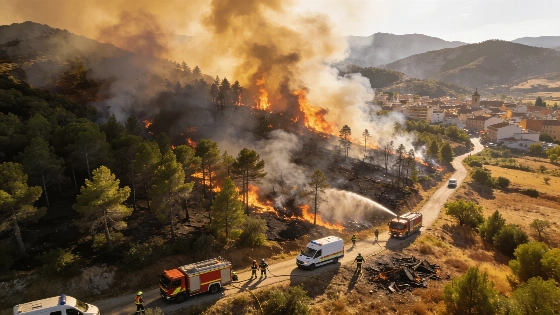
Authorities have ended the evacuation for 6,000 residents in La Vall d’Uixó. The wildfire, active for four days, continues to threaten mountain areas. Restrictions remain in place for other affected municipalities.
After four days of uncertainty, nearly 6,000 residents of La Vall d’Uixó in Castellón province have been allowed to return to their homes. The Generalitat Valenciana lifted the evacuation order for the neighborhoods closest to the mountains, as well as the general confinement for the entire town of 32,000 people. This decision comes even as the wildfire that began on Saturday remains active and uncontrolled in the Sierra de Espadán natural park.
While the immediate threat to La Vall d’Uixó has diminished, the fire has shifted deeper into the mountains, now affecting the municipalities of Eslida and Betxí. The blaze has already scorched approximately 8,500 hectares, with a perimeter stretching around 72 kilometers. According to the 112 Comunitat Valenciana emergency service, evacuation and confinement measures continue for other towns impacted by the fire and are expected to remain in force until at least 23:59 on July 28.
Firefighting teams, including aerial units, have been working since early morning to contain the flames across the affected region. The State Meteorological Agency (Aemet) reported calm weather overnight, with light winds and high humidity—up to 90% in the mountains and around 80% in the valleys. Temperatures hovered near 20ºC on flat terrain and dropped to 18ºC in higher areas. However, the formation of low-level thermal inversions due to nighttime cooling could reduce visibility and worsen air quality in the fire zone, complicating firefighting efforts.
Despite the partial lifting of restrictions, the situation remains unstable for many communities. The fire’s unpredictable movement and the scale of the affected area have kept emergency protocols in place elsewhere. In recent days, large-scale evacuations have become more common across Spain, as seen when thousands were forced to leave their homes in Castellón during a previous wildfire emergency.
Wildfires are a recurring challenge in Spain’s Mediterranean regions, particularly during the dry summer months. The Sierra de Espadán, known for its dense forests and rugged terrain, is especially vulnerable to fast-spreading fires. Local authorities continue to monitor weather conditions closely, as shifts in wind or humidity can quickly alter the fire’s behavior. The ongoing response highlights the importance of coordinated action between regional governments, emergency services, and meteorological agencies to protect residents and limit environmental damage.