A truck fire on the AP-7 near Cerdanyola del Vallès brought traffic to a standstill for 13 kilometres. Emergency crews are working to control the blaze. Nearby routes and Barcelona’s Ronda Litoral are also heavily affected.
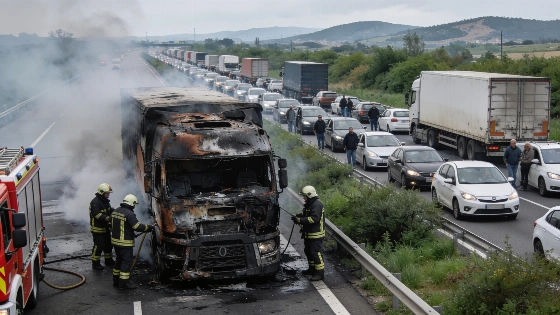
Thousands of drivers were stuck in heavy traffic this morning after a truck caught fire on the AP-7 near Cerdanyola del Vallès. The southbound lanes were nearly at a standstill, with tailbacks stretching 13 kilometres and causing problems on other main roads around Barcelona. The fire started just after 6:20 a.m., leaving only one lane open while firefighters tried to put out the flames and keep the situation from getting worse.
The disruption quickly spread beyond the AP-7. Commuters on the B-30 and C-58 faced long delays, with traffic jams from Mollet del Vallès to Badia del Vallès and Sant Cugat del Vallès, and further north between the Trinitat interchange and Ripollet. The Servei Català de Trànsit advised drivers to use the C-58, B-40, or A-2 as alternatives, but the main highway remained blocked by emergency crews.
By 7:30 a.m., the AP-7 southbound queue had reached approximately 14 kilometres, while the B-30 corridor saw at least 10 kilometres of congestion between Sant Cugat del Vallès and Badia del Vallès.
At the scene, four fire units responded at kilometre 151.2 of the AP-7. The truck’s cab was already destroyed, and the fire had spread to the trailer, which was carrying frozen goods. According to Servei Català de Trànsit, all three lanes were closed around 7:00 a.m. Only one lane reopened about half an hour later, allowing some traffic to move again. The size of the fire forced authorities to keep access restricted, making the morning commute even worse for drivers heading toward Tarragona and beyond.
Barcelona was also affected. The Guardia Urbana closed all entrances to the Ronda Litoral at Morrot de Montjuïc to remove another damaged truck that had blocked the road since 8 a.m. By 9 a.m., traffic on the Ronda Litoral was backed up for 9.5 kilometres, reaching as far as Sant Adrià de Besòs. Only exit ramps were open to help ease the pressure on the city’s ring road.
The AP-7 remains one of Catalonia’s most congested highways, and even a localized emergency can quickly paralyze several corridors, including the B-30 and approaches to Barcelona. This vulnerability was highlighted by the events of September 3, 2026, as reported by La Vanguardia and Servei Català de Trànsit.
For drivers, the morning showed how a single accident can bring the region’s main transport routes to a halt. The AP-7 is essential for both local and long-distance traffic, and its weakness to disruption has been seen before, including during the earlier breakdown of Spain’s traffic management protocols.
While emergency services worked to clear the scene, the impact was immediate: lost time, missed appointments, and problems for businesses waiting on deliveries. The fact that a truck carrying frozen goods could cause such widespread disruption shows how fragile Catalonia’s road network can be under stress. With alternative routes quickly overwhelmed and city roads like the Ronda Litoral partly closed, today’s events highlight the need for better traffic management and faster emergency response. Until these issues are addressed, even routine accidents can lead to major delays for residents, commuters, and the local economy.