From October, Spain will introduce a new traffic light sequence. The DGT will prohibit vehicles from seeing amber while pedestrians have green. The change aims to reduce confusion and improve safety at crossings.
Spain’s Dirección General de Tráfico (DGT) has announced a significant change to the country’s traffic light system, set to take effect from October. The new regulation will alter the sequence of lights at pedestrian crossings, specifically targeting the overlap between amber for vehicles and green for pedestrians. This adjustment is designed to eliminate situations where drivers and pedestrians might misinterpret signals, a scenario that has previously led to confusion and potential risk at busy intersections.
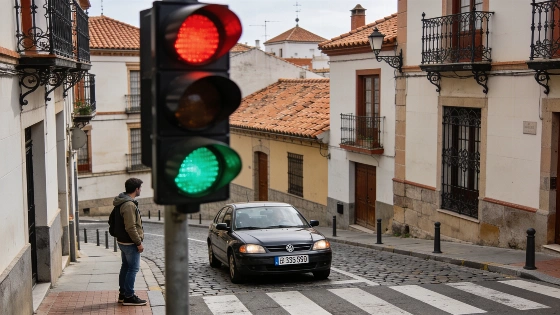
Under the current system, it is possible for vehicles to encounter an amber (naranja) light while pedestrians simultaneously have a green signal to cross. The DGT has identified this overlap as a source of misunderstanding: drivers may believe they are still permitted to proceed with caution, while pedestrians assume it is safe to cross. To address this, the new rule will make it incompatible for vehicles to have an amber light when pedestrians have green. According to the updated regulation, “at pedestrian crossings with traffic lights, as a general rule, the flashing amber for vehicles may not coincide with the green for pedestrians.”
The change will be implemented across Spain from 1 October, affecting all urban and interurban crossings equipped with traffic lights. The DGT’s decision follows a review of accident data and aims to strengthen pedestrian safety by removing any ambiguity in signal interpretation. Local authorities will be responsible for updating the programming of traffic lights to comply with the new standard. The measure is expected to impact daily routines for both drivers and pedestrians, especially in densely populated areas where foot traffic and vehicle flow intersect frequently.
This update comes as part of a broader effort to modernize Spain’s road safety regulations. In recent years, the DGT has introduced several initiatives to improve mobility and reduce accidents, including stricter speed limits in urban zones and enhanced monitoring of high-risk crossings. The focus on traffic light synchronization reflects a growing recognition of the need for clear, unambiguous signals in complex urban environments. Similar concerns about transport safety have been highlighted in other contexts, such as when rail services were disrupted between Vic and Manlleu due to a fallen tree, underscoring the importance of reliable infrastructure for public safety.
For context, Spain’s traffic light system has traditionally followed a sequence familiar across much of Europe, with green, amber, and red phases for vehicles and corresponding signals for pedestrians. The upcoming change will require technical adjustments to thousands of intersections nationwide. While the DGT has not specified the exact number of crossings affected, the measure is expected to be one of the most visible updates to Spanish road rules in recent years. The move aligns with broader European trends prioritizing pedestrian rights and accident prevention in urban planning. As the October deadline approaches, local governments and transport authorities are preparing to implement the new standard, aiming to ensure a smooth transition and greater clarity for all road users.