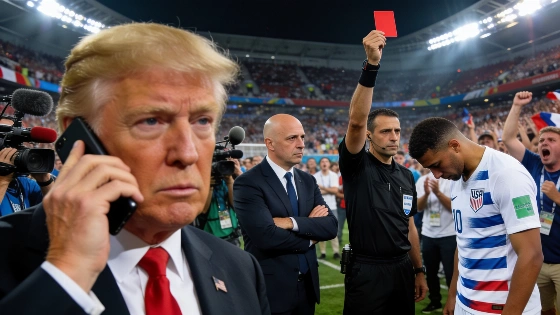
Donald Trump confirmed he called FIFA’s Gianni Infantino to discuss the red card given to Balogun. The move has triggered controversy over the independence of refereeing at the 2026 World Cup.
Controversy erupted at the 2026 World Cup after Donald Trump, president of the United States, acknowledged he personally contacted FIFA president Gianni Infantino to request a review of the red card shown to American striker Balogun. The admission has intensified scrutiny over the neutrality of refereeing decisions at the tournament, with concerns mounting about political influence at the highest level of international football.
According to statements from both sides, Trump’s intervention came shortly after Balogun was sent off in a crucial World Cup match. Infantino confirmed the conversation, emphasizing that all disciplinary matters would be handled by FIFA’s independent bodies, in an effort to dispel doubts about external interference in the competition’s proceedings.
The incident has quickly become a focal point of debate, not only among football officials but also in diplomatic circles. The direct involvement of a head of state in a disciplinary process is highly unusual and has raised questions about the boundaries between sport and politics. While FIFA has faced previous challenges regarding its governance and decision-making, this episode stands out for the explicit nature of the intervention.
Recent years have seen FIFA under pressure to maintain transparency and fairness, especially during high-profile tournaments. The organization’s response to Trump’s call is being closely watched, as any perception of bias could undermine confidence in the integrity of the World Cup. This is not the first time FIFA has had to address extraordinary circumstances during the tournament; for example, the governing body recently made headlines when it rescheduled a major match due to weather concerns, as detailed in a report on FIFA’s decision to move the Mexico-England game.
FIFA’s disciplinary procedures are designed to operate independently from outside influence, with panels tasked to review incidents based solely on the rules of the game. The Balogun case now serves as a test of these safeguards. For Spain and other footballing nations, the episode is a reminder of the delicate balance between sporting autonomy and the interests of powerful stakeholders. As the World Cup progresses, the handling of this situation may set a precedent for how similar interventions are managed in the future, reinforcing the importance of clear boundaries between political leaders and the governance of international sport.
In the broader context, the World Cup remains one of the most watched sporting events globally, with millions of viewers in Spain and across Europe. Any controversy involving top officials or players can have ripple effects, influencing public perception and the reputation of the tournament. The outcome of FIFA’s review process in the Balogun case will be closely monitored, as it may shape expectations for transparency and fairness in future competitions.