Kia EV4 vs Volkswagen ID.3: The Battle of Electric Hatchbacks for Leadership. The Kia EV4 and Volkswagen ID.3 fall within the same price range but deliver different experiences. Space, comfort, dynamics, and charging details — what matters most to buyers, and who comes out on top in a real-world comparison?
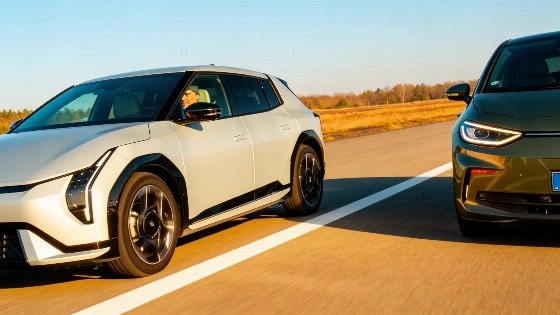
Comparing the Kia EV4 and Volkswagen ID.3 immediately highlights their different approaches: the Korean electric car looks bold and even provocative, while the German one is restrained and friendly. The EV4, with its curved hood and distinctive crossbar on the roof, looks like a concept car that rarely makes it to mass production. For those who prefer classic design, there is also a fastback version, but it deviates even further from familiar lines.
Both cars in their top trims cost about the same—around €52,000 for the tested versions with maximum equipment. The Kia EV4 with an 81.4 kWh battery is assembled in Slovakia and starts at €45,000, while the Volkswagen ID.3 with a 79 kWh battery starts at a similar price. Thus, the choice between them is not a matter of budget, but of priorities.
Size and space
The Kia EV4 is noticeably larger: its length of 4.45 meters and width of 1.86 meters put it close to the mid-size class, while the ID.3 remains within compact dimensions (4.27 m and 1.81 m, respectively). This is immediately noticeable inside: the EV4's front seats offer more airiness and freedom than its rival. However, in the second row, the Korean electric car unexpectedly falls short—the seats are set too low, the knee angle is uncomfortable, and the backrest is not adjustable. For tall passengers, this could be an issue on long journeys.
Volkswagen ID.3, on the other hand, offers superior seating comfort, especially if you choose the Plus package with top-tier sport seats. The rear row isn’t especially spacious, but for a compact hatchback there’s enough room for adults. The ID.3’s trunk is smaller (from 385 to 1,267 liters), while Kia offers from 435 to 1,415 liters. Neither car offers a front trunk (frunk), which might surprise electric car enthusiasts.
Interior and equipment
Inside, the Kia EV4 feels modern: the wide dashboard with a digital cluster and 12.9-inch central display creates a cinematic effect. The multimedia menus can sometimes lag, but the navigation is informative and helps plan charging stops. The cabin lacks a massive center console, which adds to the sense of space.
After the 2023 facelift, the Volkswagen ID.3 features a more pleasant touch, has gotten rid of excessive hard plastics, and retains its simplicity. There are separate screens for instruments and multimedia, and the climate system is controlled via touch sliders. The driver assistance system operates smoothly and predictably, though you have to pay extra for the extended IQ.Drive package.
Performance and comfort
Volkswagen ID.3 offers balanced handling and a comfortable suspension—especially with the optional DCC adaptive dampers (€1,160). In individual mode, you can select from 15 stiffness levels, and in the softest setting, the ID.3 is genuinely impressive in its ride comfort. Rear-wheel drive eliminates steering disturbances under acceleration, which adds to driving enjoyment.
The Kia EV4 has also made progress in terms of suspension: it absorbs bumps smoothly, but on potholes and rebound from the shock absorbers, the rear axle can bounce. On cobblestone, the EV4 is slightly noisier than the VW, and some noises come from the central pillar area. The steering has improved but still feels less precise, and the driver aids sometimes act too abruptly, accompanied by frequent audible alerts.
In terms of performance, the Kia EV4 (204 hp) accelerates from 0 to 100 km/h in 7.9 seconds, but the acceleration feels calmer than the numbers suggest. The Volkswagen ID.3 is faster—7.0 seconds to 100—but its top speed is lower (160 km/h versus 170 for the Kia). However, the EV4 has more effective brakes: 34.7 meters from 100 km/h compared to 36.4 for the ID.3.
Range and charging
The difference in range is minimal: at a consumption of 22.5 kWh per 100 km, the ID.3 covers 381 km, while the EV4, with a slightly larger battery and 23.2 kWh consumption, manages 385 km. When charging, the Kia doesn't set records for peak power (128 kW) but sustains it longer and charges from 10 to 80% in 31 minutes. The Volkswagen ID.3 Pro S can reach 185 kW, but quickly reduces its power after peaking, allowing it to beat the Kia by about five minutes on a fast charge.
Conclusions and nuances
Following the test, the Kia EV4 scored 585 out of 800 points: a spacious cabin and trunk, excellent brakes, but an inconvenient second row and less favorable resale prospects. The Volkswagen ID.3 came just ahead—587 points: balanced handling, comfortable seats, fast charging, but essential options are hidden in expensive packages. Both cars received the same final rating—1.8 on the AUTO BILD scale.
For those choosing between modern electric cars, it's important to consider not only the numbers but also personal priorities: comfort, dynamics, charging convenience, and interior features. If you're interested in comparing other popular models, check out the article on the rivalry between the Citroën C4 and the Seat León — an analysis of two approaches to compact hatchbacks on the Spanish market.