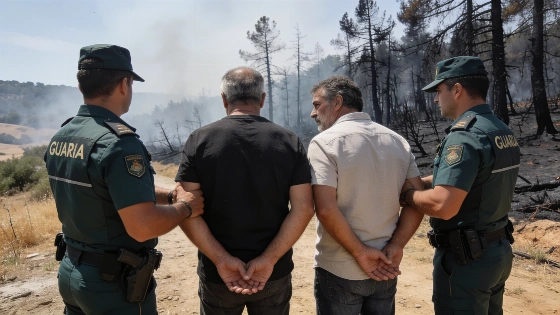
The Guardia Civil detained two men in Almorox after a wildfire spread into Madrid. Investigators blame banned welding during extreme fire risk. The case now moves to court as authorities examine the causes.
Spanish authorities have detained two men, aged 51 and 42, in Almorox (Toledo) on suspicion of causing the wildfire that devastated parts of the region and later spread into the Community of Madrid. The arrests, carried out by the Guardia Civil at 8:55 a.m., follow an investigation that points to serious negligence: both men were allegedly performing welding work on a forested plot despite a strict ban due to the area's extreme fire risk at the time.
According to sources cited by EL PAÍS, the welding activity took place on private land within Almorox, where all such work was temporarily prohibited. The fire began in a residential area of the town and quickly crossed into Villa del Prado in Madrid, merging with two other active blazes. This chain of events contributed to the formation of the Sierra Oeste megafire, now considered the largest wildfire in Spain, with more than 60,000 hectares affected across Ávila and Madrid.
The suspects are expected to appear before the Court of Instruction No. 2 in Torrijos, which is handling the legal proceedings related to the incident. The investigation suggests that the men’s disregard for the ban on high-risk activities directly led to the outbreak, as the fire danger index was officially classified as “extreme” at the time. The authorities are treating the case as a matter of public safety, given the scale of the destruction and the risk to nearby communities.
This incident comes amid a series of severe wildfires in central Spain, with emergency services stretched thin and local governments implementing new restrictions to prevent further outbreaks. The rapid spread of the Almorox fire and its impact on Madrid’s outskirts echo concerns raised in recent coverage, such as the critical situation faced by Ávila and Madrid during the peak of the wildfire crisis.
Spain’s wildfire season has grown increasingly dangerous in recent years, driven by prolonged drought, high temperatures, and changing land use patterns. The country’s legal framework imposes strict penalties for negligence during periods of elevated fire risk, especially when prohibited activities are involved. The Almorox case highlights the ongoing challenge of enforcing these rules and the severe consequences when they are ignored. As the judicial process unfolds, attention remains focused on both accountability and the broader need for prevention in vulnerable rural areas.