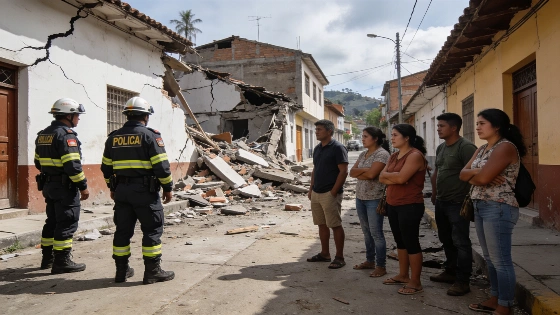
A rare and powerful earthquake in Colombia has left nearly 240 dead. Experts warn of possible aftershocks and highlight the unusual nature of the event. The risk of further seismic activity remains high.
Colombia is facing the aftermath of a devastating earthquake that has claimed close to 240 lives, with authorities and scientists warning that the situation remains unstable. According to Fabio Florindo, president of the Istituto Nazionale di Geofisica e Vulcanologia (INGV) in Italy, the seismic event stands out as highly unusual for the region, both in its intensity and in the rarity of such occurrences.
Florindo notes that, since 1950, only two earthquakes of similar or greater magnitude have been recorded within 250 kilometers of the current epicenter. This rarity, combined with the strength of the quake, has led experts to classify it as an anomalous event. The United States Geological Survey (USGS) reported that the earthquake originated at a depth of around 100 kilometers, a factor that, contrary to common belief, can actually allow seismic waves to travel further and impact a wider area.
The underlying cause is linked to the complex tectonic dynamics of the region. The Nazca Plate, which extends from the Pacific Ocean to the South American coast and even reaches Easter Island, is subducting beneath South America at an average rate of 8 centimeters per year. This process is not uniform, with periods of acceleration that increase the risk of significant energy release. The recent quake, measured at 7.4 on the Richter scale, reflects the sudden discharge of this accumulated energy, resulting in extraordinary destructive power.
Initial data suggest that a major fault rupture occurred within the Nazca Plate during the subduction process, with the fault estimated to be at least 110 kilometers long. Such a rupture not only explains the scale of the disaster but also raises concerns about the potential for further seismic activity. Florindo warns that aftershocks are almost certain, though their magnitude cannot be predicted. The activation of additional faults triggered by the main event could prolong the period of instability, possibly for months, with varying intensity.
Despite the proximity of a recent catastrophe in neighboring Venezuela, Florindo rules out any direct connection between the two events. He emphasizes that there is no evidence linking the Colombian earthquake to those in Venezuela, noting that the vastness of the Nazca Plate means powerful quakes can occur independently along the western coast of South America.
Colombia's geological monitoring systems remain on high alert. The Colombian Geological Service, in cooperation with the USGS and other international partners, continues to monitor the situation and share data. According to Florindo, these collaborations are crucial for understanding seismic risks in such a complex region.
For context, Colombia sits on the Pacific Ring of Fire, one of the most seismically active zones in the world. The country's western regions are particularly vulnerable due to the ongoing subduction of the Nazca Plate. While major earthquakes are rare, the potential for significant damage remains high, especially in densely populated or poorly constructed areas. The recent event underscores the importance of robust monitoring and preparedness measures, as well as international scientific cooperation in managing seismic risks.