Making Spanish neighborhoods more attractive often leads to higher housing costs, hitting low-income families hardest. Economist Joan Monràs argues that without more homes, upgrades can push out existing residents and widen social divides.
When city authorities invest in parks, public spaces, or better services, the goal is to improve daily life. But for many Spanish families, these upgrades come with a hidden cost: rising housing prices that can force longtime residents to leave their own neighborhoods. Joan Monràs, director of the Barcelona School of Economics and professor at Universitat Pompeu Fabra, has become one of the most prominent voices warning about this unintended consequence.
Monràs points out that low-income households in Spain spend around 40% of their budget on housing, compared to just 20% for wealthier families. This means that even modest rent or price increases hit the most vulnerable residents much harder. According to his research, developed with Bryan A. Stuart and supported by a BBVA Foundation Leonardo Grant, the growing gap in housing costs is a key driver of inequality.
Housing Burden and Social Divide
Recent data from Spain’s Family Budget Survey shows that average household spending on housing, utilities, and energy rose by 5.8% in 2025. Meanwhile, the average household income stands at €38,994, but 25.7% of the population remains at risk of poverty or social exclusion. As Monràs explains, when housing costs rise, families with fewer resources are often the first to feel the pressure, sometimes having to relocate to less desirable areas.
Monràs argues that increasing the supply of homes is the most effective way to ease this burden. If more housing is built and prices stabilize or fall, the benefits are felt most by those who spend a larger share of their income on rent or mortgages. His analysis suggests that a 10% boost in residential sector productivity could reduce overall welfare inequality by about 1%.
Urban Renewal and Displacement
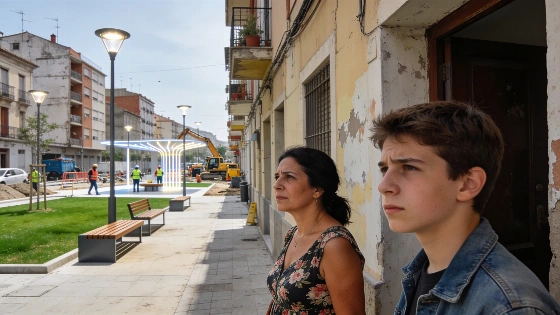
The problem intensifies when city improvements make a neighborhood more attractive but the housing supply remains tight. New parks, pedestrian zones, and upgraded services draw in higher-income newcomers, driving up demand and prices. As Monràs puts it, “improving quality of life in the city can end up pushing residents out of their own neighborhoods.”
He does not argue against investing in urban renewal. Instead, he insists that such projects must be paired with policies to expand housing options. Without this, only those with greater financial means can absorb the higher costs, while others are forced to move. The issue is especially acute in Spain’s rental market, where finding affordable options is already a challenge for many households.
Connecting Cities to Ease Pressure
Monràs also proposes a broader solution: better connecting nearby cities to major hubs like Madrid and Barcelona. Improved commuter rail and telecommunications infrastructure could integrate towns such as Mataró, Sabadell, and Terrassa into the wider metropolitan economy. This would allow more people to access jobs and services without being confined to the most expensive urban centers.
While greater connectivity can raise prices in outlying areas, it also reduces commuting costs and can improve quality of life for residents. The sharp differences in rental prices across Spain reflect this dynamic—some cities face intense pressure, while others remain much more affordable. The challenge is to ensure that living further from the center does not mean losing access to opportunity.
Lessons from Catalonia’s Rent Caps
Monràs’s research with economist José García Montalvo on Catalonia’s 2020 rent controls found mixed results. Rents above the official index fell, but some below the cap actually increased. At the same time, a portion of higher-priced rental properties disappeared from the market. In Barcelona, the relative supply of rental homes dropped by about 10% compared to similar cities without the cap. The study also noted a nearly 20% decrease in listings above the reference price and a 7% increase among those below it. These findings highlight the complexity of regulating rents without addressing underlying supply issues.
Policy Dilemmas and the Path Forward
Balancing vibrant, attractive cities with affordable housing remains a central dilemma for Spanish policymakers. Monràs’s work suggests that the only sustainable path is to expand the housing stock while investing in neighborhoods and improving regional connections. Without these measures, economic growth risks leaving behind those who already devote the largest share of their income to keeping a roof over their heads.
As Spain faces mounting pressure to modernize its housing and energy infrastructure, the debate over who benefits from urban renewal is likely to intensify. For example, new EU rules now require Spain to cut residential energy use by 16% by 2030, with the oldest buildings facing the first upgrades—a move that could further impact housing costs and availability, as detailed in this recent analysis of EU energy efficiency targets.