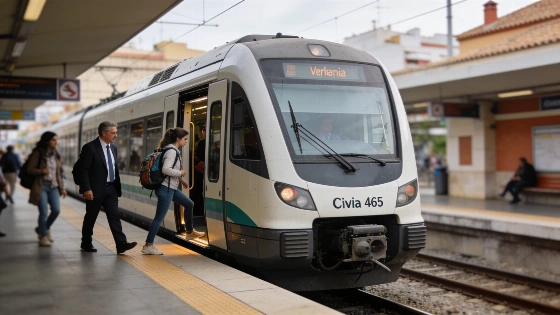
From September, Valencia’s Cercanías network will see a 30% capacity increase. The arrival of 41 Civia 465 trains enables more frequent service on key routes. The upgrade targets growing demand and student schedules.
Valencia’s Cercanías rail network is set for a major upgrade this September as Renfe introduces 41 Civia 465 trains, increasing capacity by 30% on the region’s busiest commuter lines. The phased rollout, starting 7 September, will bring more frequent service to lines C1 (Valencia-Gandía), C2 (Valencia-Xàtiva-Moixent), and C6 (Valencia-Castelló de la Plana), directly responding to rising passenger numbers and the need for better alignment with university timetables.
On the C1 route, ten additional daily services will be added, while the C6 line will see seven more. Both lines will reach a total of 79 circulations each day. The C2 line will also benefit from increased frequencies as the new trains are gradually deployed throughout September. This expansion is designed to better serve the schedules of students at the Universidad Politécnica de Gandía, among other commuters.
The Civia 465 units, previously operating in Madrid, are more modern and spacious than the trains they replace. Each train offers 748 seats—significantly more than the 549 available on outgoing models—and provides 277 seated places, up from the previous 219–233. Renfe has invested over €7 million in refurbishing these trains, including technical inspections, interior and exterior upgrades, and updated passenger information systems. In total, maintenance and upgrades for the Civia fleet have exceeded €87 million.
This fleet renewal is part of a broader reorganization of Renfe’s public service trains, aiming to match rolling stock to the specific needs of each region. In Valencia, the focus is on boosting capacity to keep pace with demand. Of the 41 Civia trains, 22 are arriving from August, with the remaining 19 scheduled for gradual introduction through 2027. The average age of Valencia’s commuter trains will drop from 27.8 to 17.2 years, making it one of Spain’s youngest suburban fleets. Given that the typical lifespan of a train is around 40 years, these units are expected to remain in service for decades.
The Civia 465 trains feature improved air conditioning and a dual independent power system for greater reliability. Their arrival in Valencia follows a strategic shift in Madrid, where infrastructure saturation prevents further increases in train frequency. Instead, Madrid is receiving new, higher-capacity trains—some accommodating up to 2,000 passengers—to address congestion, especially in heavily used urban tunnels. As a result, the Civia units have been redeployed to Valencia, where they can make a more immediate impact.
Some of the older 447 series trains currently operating in Valencia will be transferred to the Basque Country, where they are compatible with local infrastructure and will help improve accessibility. This redistribution of rolling stock is part of Renfe’s ongoing efforts to optimize its fleet nationwide.
Spain’s regional rail networks face varying challenges. For example, Madrid’s Cercanías handles over 200 million journeys annually—ten times Valencia’s volume—requiring different solutions for each area. The current changes in Valencia reflect a targeted response to local needs, aiming to deliver more reliable and comfortable service for daily commuters and students alike. For context on how weather events can also disrupt transport in Spain, see this report on recent storms affecting travel across the country.
Renfe’s investment in Valencia’s commuter rail is part of a broader modernization push across Spain’s public transport sector. As the new Civia 465 trains enter service, passengers can expect not only more frequent departures but also a noticeable improvement in comfort and reliability. The move underscores the importance of adapting infrastructure and rolling stock to the evolving demands of Spain’s urban and regional mobility.