Volkswagen is betting on compact electric cars to reach a million vehicles produced in Spain and Portugal by 2027. The launch of the ID.Cross in Navarra marks a turning point, with new models and expanded factories reshaping the region’s automotive landscape.
Volkswagen is targeting a milestone that would have seemed ambitious just a few years ago: producing one million vehicles in Spain and Portugal by 2027, driven by a new generation of compact electric cars. The start of ID.Cross production at the Navarra plant marks a significant shift in the German group’s Iberian strategy. According to leading Spanish business publications, this goal relies on the combined capacity of Volkswagen’s three main regional plants—Martorell, Navarra, and Palmela—which are expected to reach full output in the coming years.
This target is underpinned by a €10 billion investment, including the Sagunto battery gigafactory in Valencia. The plan brings together four key electric models: Cupra Raval and VW I.D Polo, assembled in Martorell near Barcelona, and Skoda Epiq alongside the new VW I.D. Cross in Pamplona. Next year, the even smaller ID.1, under four meters in length, will join the lineup from Palmela, Portugal, further expanding Volkswagen’s presence in the region. Local industry sources confirm that all these models will use batteries from PowerCo’s Sagunto gigafactory, creating a tightly integrated regional supply chain.
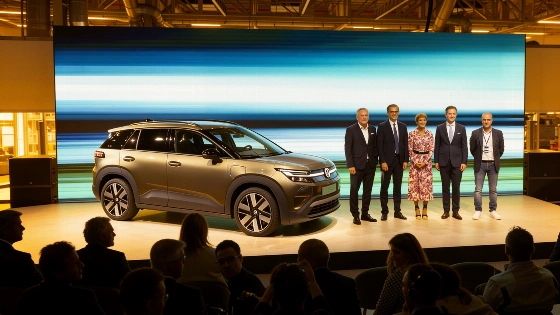
The official start of serial production for the VW ID.Cross at the Navarra plant in Landaben was confirmed on September 18, 2026, marking the addition of a new electric crossover to the factory's lines.
André Kleb, responsible for Volkswagen’s production across the Iberian Peninsula, has stated that the addition of these models could push the group to its all-time production record in the region as early as next year. For the Landaben factory in Navarra, operating since 1966, this is a pivotal moment. Once the home of the VW Polo—with over eight million units produced until two years ago—the plant now produces combustion models like the VW T-Cross and Taigo alongside new electric vehicles, including the Skoda Epiq and ID.Cross. Regional economic outlets report that Landaben’s current production officially includes these four models, with both electric and combustion vehicles sharing the same lines.
Half of Landaben’s output is now set to be electric, a shift that not only increases industrial flexibility but also drives workforce growth. The plant’s staff has grown by more than 1,000 in recent months, reaching nearly 5,500 employees to support the electric transition. With the arrival of two new EVs, Volkswagen expects Landaben to reach a record 360,000 units produced in 2027. Local press, citing Volkswagen Navarra’s management, notes that the factory aims to surpass its previous record of 353,353 vehicles set in 2011.
At the official launch of the ID.Cross, María Chivite, president of the Government of Navarra, described the project as a model of public-private collaboration. She emphasized that government support has focused on innovation and job creation, highlighting the broader economic impact. Volkswagen CEO Thomas Schäfer praised the Navarra plant’s ability to reinvent itself, stressing its new focus on "attractive and affordable cars."
From September to the end of 2026, Volkswagen Navarra plans to produce 24,300 units of the ID.Cross, according to local press reports citing plant management. This rapid ramp-up is part of a broader strategy that will see nearly half of Landaben's total output become electric, making it one of the most flexible sites in the Volkswagen Group.
The push for electrification is not unique to Volkswagen. As reported earlier, other manufacturers are also expanding electric and hybrid offerings to meet evolving demand and regulatory requirements across Europe.
Volkswagen’s approach in Spain and Portugal goes beyond production numbers. By focusing on small, accessible electric vehicles and investing heavily in local manufacturing, the group is positioning itself to shape the next phase of the Iberian auto industry. The scale of hiring, the shift in model mix, and the integration of battery production all signal a transformation that could redefine the region’s industrial landscape. If Volkswagen meets its production targets, it will not only secure its future in Spain and Portugal but also set a benchmark for how established automakers can adapt to the electric era while maintaining their manufacturing base. According to several Spanish and European automotive news outlets, Volkswagen’s strategy is being closely watched as a potential model for large-scale electrification in traditional carmaking regions.